
Scientists at the DIII-D National Fusion Facility are investigating a different tokamak operating approach that holds promising results for future fusion power plant designs.
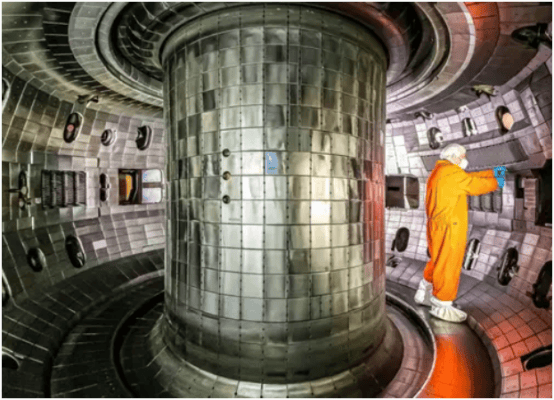
Recent experiments show that a plasma configuration known as “negative triangularity” can achieve the high-performance conditions required for sustained fusion energy while addressing key heat management challenges inside reactors. In 2023, the DIII-D facility conducted dedicated experimental campaigns to evaluate this operating mode. The results indicate that negative triangularity plasmas can produce stable conditions that meet—and in some cases exceed—the requirements for future fusion pilot plants. Previously, the fusion community had predicted that this plasma shape would be less stable than conventional methods, making these findings particularly noteworthy.
Tokamaks are at the heart of fusion energy research, using powerful magnetic fields to confine and shape plasma (the state of matter where atoms are heated to extreme temperatures and separated into ions and electrons) with the goal of harnessing energy released from nuclear fusion. For fusion power plants to be economically viable, tokamaks must simultaneously achieve high plasma pressure, high current, and high density while effectively managing heat.
The negative triangularity configuration changes the plasma cross-sectional shape from the conventional “D” to an inverted “D,” with the curved portion facing the inner wall of the tokamak. In DIII-D experiments, this shape exhibited unexpectedly low instability, allowing researchers to simultaneously achieve high pressure, high density, and high current, while observing good thermal confinement in the plasma.
One of the major challenges in tokamak design is core-edge integration—maintaining a sufficiently hot plasma core (where fusion reactions occur) while keeping the plasma edge cool enough to prevent heat damage to the device walls. Negative triangularity experiments offer a potential solution to this problem. Researchers demonstrated for the first time the combination of high plasma confinement with “divertor detachment” in this shape, forming a cooler boundary layer that reduces heat flux and electron temperature at the material surface, achieving an integrated core-edge solution while maintaining plasma edge stability.
Scientists are now using advanced simulation tools to study these divertor conditions more closely, enabling more confident extrapolation of the results to future fusion power plant designs.
In a press release, the researchers summarized that these features indicate the significant potential of negative triangularity and support further exploration of this regime for fusion pilot plant design and development. Advantages of the negative triangularity effect include better suppression of plasma instabilities (which can cause bursts of particles and energy) and reduced damage to tokamak walls—one of the major concerns for fusion reactors.
Notably, in January of this year, the SMART (Small Aspect Ratio Tokamak) fusion reactor—the world's only tokamak with a “negative triangularity” structure, built by the University of Seville in Spain—produced its first plasma.