
A collaborative research team from Rice University has discovered direct evidence of active flat electronic bands in the kagome superconductor CsCr₃Sb₅. The findings were published in the journal Nature Communications. This discovery provides new directions for quantum materials design and may drive future developments in electronic technologies.
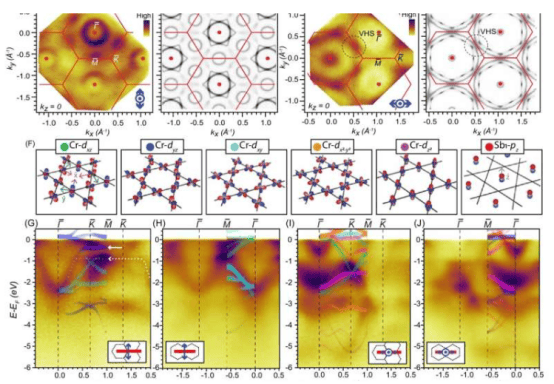
The research was led by Professor Pengcheng Dai, Associate Professor Ming Yi, and Professor Qimiao Si from the Department of Physics and Astronomy at Rice University, in collaboration with the National Synchrotron Radiation Research Center in Taiwan. Using angle-resolved photoemission spectroscopy (ARPES) and resonant inelastic X-ray scattering (RIXS) techniques, the team observed that flat electronic bands in chromium-based kagome metals actively participate in the formation of quantum states. This material, featuring a two-dimensional lattice of corner-sharing triangles, exhibits superconductivity under pressure.
Professor Pengcheng Dai stated: “The results confirm theoretical predictions and establish a viable path for designing exotic superconductivity through chemical tuning.” Experimental data show that the flat electronic bands in CsCr₃Sb₅ crystals are not inert as in most materials but directly participate in and influence the material's electromagnetic properties. The study utilized larger and higher-purity crystal samples, with volumes 100 times larger than those in previous research.
Associate Professor Ming Yi noted: “By identifying active flat electronic bands, we have confirmed a direct link between lattice geometry and quantum states.” Professor Qimiao Si added: “The ARPES and RIXS results show consistency, indicating that flat electronic bands are not mere spectators but active participants in shaping the electromagnetic landscape. Such features previously existed only in theoretical models.”
The findings are supported by a tailored electronic lattice model that successfully reproduces the observed characteristics. Co-first author and Rice University graduate student Zehao Wang stated: “Obtaining precise data required exceptionally pure large-sized crystal samples.” Another co-first author, Yucheng Guo, emphasized: “This achievement is the result of multidisciplinary collaboration in materials synthesis, spectroscopic characterization, and theoretical modeling.”
The discovery offers new insights for the design of superconductors, topological insulators, and spintronic devices, demonstrating the potential of kagome lattice geometry to manipulate electronic behavior.