
A review paper on the latest trends and advances in achieving intuitive human-robot interaction (HRI) using bio-potentials and bio-impedance has been published in Nature Reviews Electrical Engineering. The joint research team is led by Professor Jung Kim from the Department of Mechanical Engineering at the Korea Advanced Institute of Science and Technology (KAIST) and Professor Min-kyu Je from the Department of Electrical and Electronic Engineering.
This review paper is the result of collaboration among Dr. Kyung-seo Park (DGIST, co-first author), Dr. Hwa-young Jeong (EPFL, co-first author), Dr. Yoon-tae Jeong (IMEC), and Dr. Ji-hoon Seo (UCSD), all of whom are PhD graduates from the two laboratories.
Nature Reviews Electrical Engineering is a review journal dedicated to the fields of electrical, electronic, and artificial intelligence technologies, newly launched last year. The journal invites world-renowned scholars in the field to contribute through rigorous selection criteria. The paper by Professor Jung Kim’s research team, titled “Using bio-potential and bio-impedance for intuitive human-robot interaction,” was published on July 18, 2025.
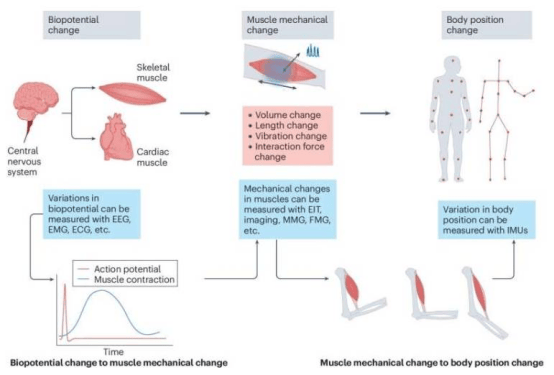
This review explains how bio-signals can be used to quickly and accurately detect motion intentions and introduces advances in motion prediction technologies based on neural signals and muscle activity. In addition, the article highlights the critical role of integrated circuits (ICs) in maximizing low-noise performance and energy efficiency for bio-signal sensing, and covers the latest development trends in low-noise, low-power designs for precise measurement of bio-potential and impedance signals.
The paper emphasizes the importance of hybrid and multi-modal sensing approaches and proposes the possibility of building robust, intuitive, and scalable HRI systems. The research team stresses that collaboration in the fields of sensors and IC design is essential for the practical application of bio-signal-based HRI systems, and points out that interdisciplinary cooperation will play a key role in the development of next-generation HRI technologies.
Co-first author Dr. Hwa-young Jeong introduced the potential of bio-potential and impedance signals to make human-machine interaction more intuitive and efficient, and predicted that it will make significant contributions to the future development of HRI technologies such as rehabilitation robots and robotic prosthetics that utilize bio-signals.