
A Chinese research team has developed a new method for generating optical vortices using van der Waals materials, a technology expected to enhance data transmission capacity in optical communication systems. The research results have been published in the journal Light: Science & Applications.
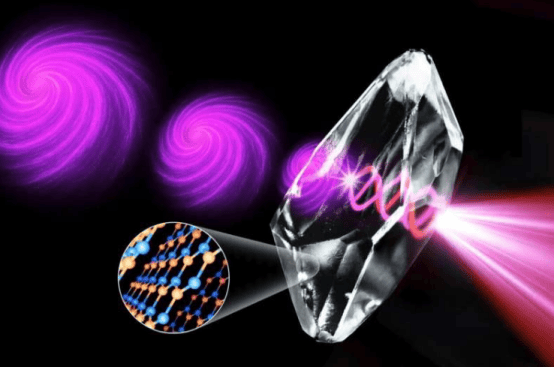
Optical vortices are special light beams with helical wavefronts capable of carrying orbital angular momentum, providing an additional dimension for information encoding in optical communications. Traditional optical vortex generators rely on complex fabrication processes or bulky crystals, whereas the new method utilizes layered van der Waals materials to manipulate the light field through their natural optical properties.
The research team conducted experiments using hexagonal boron nitride (h-BN) and molybdenum disulfide (MoS₂), two van der Waals materials. When circularly polarized light passes through these ultrathin materials, their birefringence causes spin flipping and forms a helical wavefront, thereby generating optical vortices. Experiments demonstrated that samples of h-BN with a thickness of only 8 micrometers and MoS₂ with a thickness of 320 nanometers could effectively produce optical vortex beams, with energy conversion efficiency approaching 50%.
The first author of the study stated: “Van der Waals materials provide a new platform for manipulating photons. The interlayer van der Waals forces ensure structural stability while facilitating the preparation of heterostructures.” This optical vortex generation technique requires no complex nanofabrication processes and achieves efficient light field control at the micro-nano scale.
Optical vortex technology can significantly increase the channel capacity of optical communication systems. Since optical vortices with different topological charges are mutually orthogonal, they enable parallel transmission of multiple signals on the same wavelength. The researchers confirmed through computer simulations that optimizing the incident beam waveform can further improve vortex conversion efficiency.
The team is currently working to enhance compatibility with existing communication technologies and exploring solutions to integrate optical vortex generators into miniature optical systems. This technology holds application potential in future satellite communications and high-speed data transmission.