
The space solar cells co-developed by the Korea Energy Research Institute (KERI) and Flexel Space are being launched into space aboard the Nuriho satellite. On August 27, the two organizations signed a technology transfer contract for CIGS (copper indium gallium selenide compound semiconductor) solar cell process technology at the “2025 Climate Industry International Expo” held at BEXCO in Busan. The value of this technology transfer is 5.5 billion KRW.
As the era of “New Space,” driven by private-sector-led space development, arrives, the production of small satellites is increasing rapidly, leading to a sharp rise in demand for space solar cells for satellites. To ensure stable power supply in the extreme space environment, multi-junction solar cells with higher efficiency than conventional silicon solar cells are required. However, existing gallium (Ga)-arsenide (As)-based multi-junction solar cell technology is monopolized by a few countries and companies, including the United States and Germany.
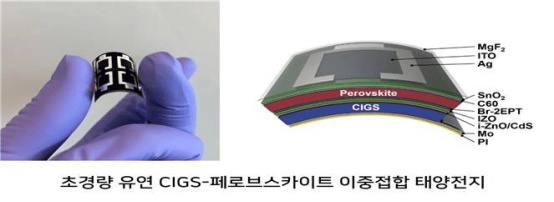
Dual-junction solar cells based on CIGS offer excellent resistance to thermal shock and radiation, enabling stable operation in extreme environments such as space. They can also be fabricated on ultra-light and flexible substrates, making them ideal for storage in satellites with strict weight and volume constraints. As a result, CIGS-based cells are attracting strong attention as a next-generation alternative to expensive gallium arsenide solar cells in the space solar cell field.
Flexel Space, a company specializing in space solar cell development, has acquired CIGS solar cell technology from the Korea Energy Research Institute and developed an ultra-light and flexible CIGS-perovskite tandem (dual-junction) solar cell optimized for the lifespan and performance of small satellites.
The solar cells developed by these two institutions will be validated in a real space environment during the fourth launch of Korea’s launch vehicle “Nuriho”, scheduled for November. Their reliability will be verified through integration with Inha University’s CubeSat “INHARoSAT,” which will be loaded onto Nuriho-4.
KERI President Lee Chang-geun stated that ultra-light and flexible thin-film solar cells for space applications are a key component technology for responding to the new space era and supporting Korea’s space security. This collaboration will lay the foundation for pioneering the next-generation space solar cell market. Flexel Space CEO Noh Shin-young remarked that the company will provide innovative solutions to the rapidly growing space solar cell market through next-generation high-performance thin-film multi-junction solar cells, continuously improving performance and productivity while preparing for future mass production.
In addition, on the same day, the Korea Energy Agency signed technology transfer contracts worth a total of 7.5 billion KRW, including the transfer of carbon dioxide capture process technology to Sangwon E&I, solar thermal hybrid module technology to Isaac Energy, and heat recovery ventilation system technology to Cleantech.