
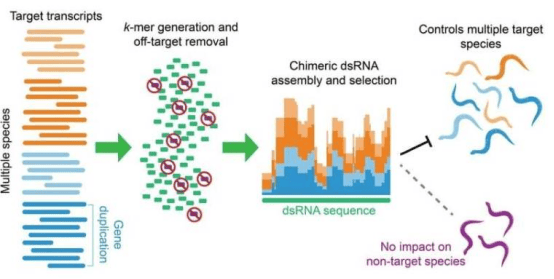
The University of Queensland has successfully developed and validated an innovative software package called dsRNAmax, which leverages RNA interference (RNAi) technology to provide a safe, effective, and chemical-free customized solution for crop protection. dsRNAmax enables precise design of double-stranded RNA (dsRNA) that specifically targets pests and pathogens while avoiding impacts on non-target species such as beneficial insects.
The software was primarily developed by PhD student Stephen Fletcher and rigorously tested in collaboration with Dr. Chris Brosnan and his team, along with the nematology team from the Department of Primary Industries (DPI). The research findings have been published in the journal NAR Genomics and Bioinformatics.
Fletcher explained: “The core philosophy of the dsRNAmax software is to tailor dsRNA specifically for the target organism. Its application is extremely broad and can be designed for virtually any organism in a given project. This means we can avoid off-target effects and incorporate as many off-target exclusion criteria as needed.”
Dr. Brosnan elaborated that dsRNA-triggered RNAi is a naturally occurring gene regulation mechanism found throughout nature. “We harness this mechanism by creating dsRNA to precisely regulate the genes we select, thereby effectively controlling pathogens and pests.”
In the validation study, the research team used three nematode species and one non-target nematode provided by the DPI nematology team as test subjects. Dr. Brosnan stated: “The dsRNAmax software successfully designed a single dsRNA capable of simultaneously targeting all relevant genes across these three nematode species, regardless of gene copy number, while having no effect whatsoever on the non-target nematode.”
“We have demonstrated through real-world experiments that the software works as intended—this is the key highlight of the paper. Additionally, our ongoing nematode research in collaboration with DPI holds tremendous promise.”
Fletcher revealed that the next phase of dsRNAmax development aims to further enhance its effectiveness. “We plan to integrate machine learning techniques to optimize dsRNA design, potentially improving efficiency by 5% to 10%. This will have a significant impact on agricultural production systems. Higher efficiency also means we can reduce the amount of dsRNA required, thereby lowering costs.”
“Close collaboration with DPI was crucial to our success, as their validation system provided strong support for releasing the software,” Fletcher added.