
A research team from Zhejiang University has published their findings in Advanced Photonics, proposing a new method to optimize perovskite thin films by introducing volatile ammonium additives, significantly improving the performance of perovskite lasers. This approach involves adding the additive during the annealing process of polycrystalline perovskite thin films, triggering a phase reconstruction process that effectively eliminates low-dimensional phase structures.
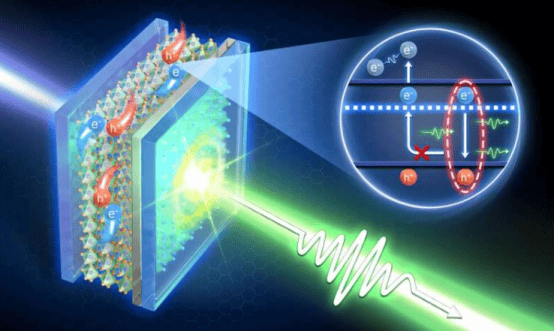
All-inorganic perovskite thin films are regarded as a promising alternative to traditional III-V semiconductor lasers due to their lower production costs and good substrate compatibility. However, perovskite lasers at room temperature suffer from rapid carrier loss due to Auger recombination under continuous or quasi-continuous operation, a long-standing issue that has limited their practical applications.
Through phase reconstruction technology, the research team successfully fabricated pure three-dimensional perovskite structures, reducing Auger recombination channels. This structure better preserves the carriers required for laser emission while avoiding significant optical losses. By analyzing the recombination processes of electrons and holes under different pumping conditions, the researchers confirmed that the optimized films exhibit outstanding carrier retention performance.
Based on the improved thin films, the team fabricated single-mode vertical-cavity surface-emitting lasers (VCSELs) that achieved a low lasing threshold of 17.3μJ/cm² and a high quality factor of up to 3850 under quasi-continuous nanosecond pumping. These metrics represent a new advancement in the field of perovskite laser research.
This study provides a technical pathway for developing high-performance perovskite lasers capable of stable operation under continuous-wave or electrically pumped conditions, holding positive significance for the future integration of photonic chips and the development of flexible optoelectronic devices.