
Researchers at Delft University of Technology in the Netherlands have succeeded in observing, in real time, the back-and-forth switching of an atomic nuclear magnet. Using the tip of a scanning tunneling microscope (STM), they read out the nuclear "spin" of electrons in the same atom.
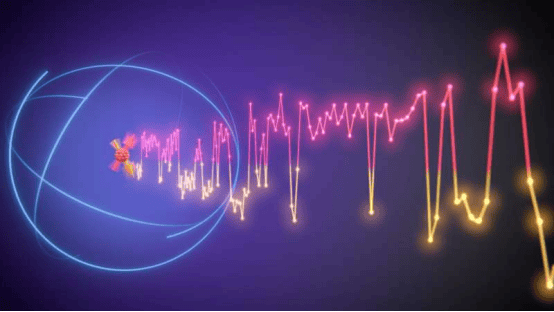
To their surprise, the spin remained stable for several seconds, offering hope for improved control over nuclear magnets. The study, published in Nature Communications, marks an advance in atomic-scale quantum sensing.
The scanning tunneling microscope (STM) consists of an atomically sharp tip that can "sense" individual atoms on a surface and generate images with atomic resolution. More precisely, the STM senses the electrons surrounding the atomic nucleus. Both the electrons and the nucleus in an atom possess tiny magnetic properties.
Depending on the type of atom, each atom carries a quantity called "spin," the quantum mechanical equivalent of magnetism. Ten years ago, the motion of a single electron spin was measured for the first time using an STM. The research group at TU Delft, led by Professor Sander Otte, wanted to know: could they also use an STM to read out, in time, another part of the atom—the nuclear spin?
Reading Out Nuclear Spin
The STM is not directly sensitive to nuclear spin, so the team had to read it out indirectly via the electrons. "A few years ago, the basic idea was already demonstrated using the so-called hyperfine interaction between electrons and nuclear spin," Otte explains. "However, those early measurements were too slow to capture the motion of nuclear spin over time."
First authors Evert Stolte and Jinwon Lee set out to perform fast measurements on an atom known to have nuclear spin. To their excitement, they observed on the computer screen real-time switching of the signal between two different energy levels.
Stolte says: "We were able to prove that this switching corresponds to the nuclear spin flipping from one quantum state to another and back again."
They determined that the spin changes took about five seconds—much longer than for many other quantum systems accessible with STM. For comparison, the lifetime of the electron spin in the same atom is only about 100 nanoseconds.
Single-Shot Readout
Because the researchers could measure the nuclear spin faster than it flips its state, and (in most cases) the measurement itself did not induce a flip, they achieved what is known as "single-shot readout." This opens exciting experimental possibilities for controlling nuclear spin. Moreover, the fundamental progress in reading out and controlling surface nuclear spins will, in the long term, contribute to applications such as quantum simulation or quantum sensing at the atomic scale.
Stolte concludes: "The first step in any new experiment is being able to measure it—and that's exactly what we've done here for nuclear spin at the atomic scale."