
A research team at Tohoku University in Japan has discovered a new material that significantly improves fuel cell performance under intermediate-temperature conditions. The results were published in the Journal of the American Chemical Society in 2025, offering a new direction for overcoming bottlenecks in intermediate-temperature fuel cell technology.
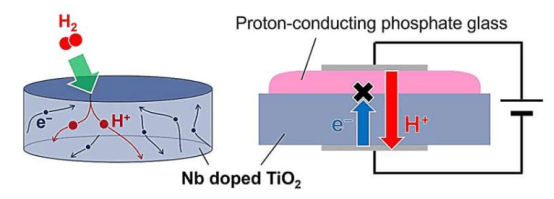
Currently, most fuel cells require operation above 500°C, whereas the newly developed niobium-doped titanium dioxide material enables efficient ionic conduction in the intermediate temperature range of 200–500°C. The study shows that niobium doping not only enhances electronic conductivity but also stabilizes the crystal structure and promotes proton diffusion, increasing the material's hydrogen absorption capacity by 10 to 100 times.
Assistant Professor Tomoyuki Yamasaki from Tohoku University stated: "Such materials are crucial for developing next-generation hydrogen energy devices, including fuel cells and hydrogen separation membranes. These devices help convert hydrogen into electricity or produce hydrogen more efficiently, thereby supporting the transition to a sustainable, low-carbon society."
The research team used a specialized proton-conducting glass electrolyte for measurements, accurately separating the effects of proton and electron conduction. The results demonstrated that the material's proton conductivity surpasses that of most known electrolytes in the same temperature range. Professor Takahisa Omata from Tohoku University noted: "This work proposes a new concept: electron donor doping can enhance proton conductivity by increasing electron density."
The study is the first to confirm the synergistic enhancement of intermediate-temperature proton and electron conduction through electron donor doping, providing a broader range of material options for fuel cells and hydrogen energy technologies.