
A straight wall is not necessarily a climate-optimized wall. Depending on how the wall receives sunlight and shade, each brick has an ideal placement angle. These calculations come from a digital design configurator, and in the future, robots will assist craftsmen in precisely positioning the bricks. Recently, the Technical University of Munich (TUM) and the Munich-Ebersberg Building Association tested this human-robot collaborative construction technique under real conditions in a workshop with bricklaying apprentices.
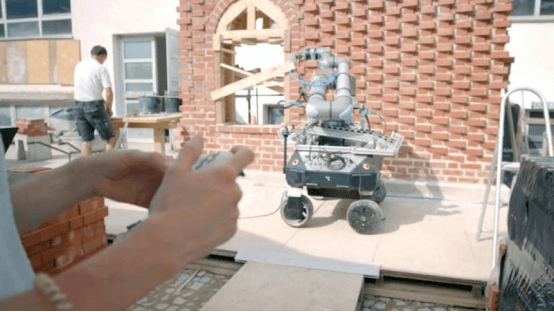
When Munich University of Technology researcher Julia Flakenstein lays bricks with apprentices from the Munich-Ebersberg Building Association, a robot is always by their side—without it, the exterior wall bricks cannot be laid. Of the 1,700 bricks, more than 200 are not placed straight facing upward but are rotated outward from the wall at different angles. This is because the wall has been climate-optimized. The digital design configurator identifies the lighting conditions at the building site and calculates the exact position for each brick to meet climate-optimization requirements.
The robot stores a digital twin of the wall, with its assembly logic integrated into the design process. Flakenstein describes the robot as a new colleague: its robotic arm is equipped with a gripper and mounted on a movable base that can travel left and right, reaching any position on an approximately 4 × 2.50 meter wall. The robot was developed by the Technical University of Munich specifically for collaborative work with humans on construction sites. Markus Bruckner, the bricklaying and plastering trainer at the association, says that the robot can provide precision beyond human limits, making construction in this way very meaningful.
The robot does not replace craftsmen but complements their skills. Three bricklaying apprentices from Bruckner participated in building this wall. Dragan Stanojevic, who will complete his training next year, says that at first it took time to get used to the robotic arm suddenly working alongside them, but now it is easy to imagine.
The project adheres to the principle of simplified construction—for example, using only bricks. Trainees no longer build complex wall structures but lay bricks layer by layer. This wall is "four heads deep," with a total thickness of 55cm—20 to 25cm thicker than conventional walls. Flakenstein explains that exterior walls should use weather-resistant clinker bricks or impregnated bricks, while interior walls use insulating bricks; this demonstration uses porous bricks. Bruckner adds that bricks enable simple and sustainable construction, and building with a single material makes disassembly and reuse easier.
The seminar was jointly initiated by Kathrin Dörfer, Professor of Digital Fabrication at the Technical University of Munich, and master craftsman Laura Lammel from the Munich-Ebersberg Building Association. Dörfer states that the seminar clearly showed that collaborative robots do not replace craftsmanship but purposefully extend it. The interplay of digital planning, robotic execution, and craftsmanship creates new possibilities in the construction process, opening future-oriented prospects for trainees. New technologies will strengthen rather than replace this craftsmanship.