
Rice serves as the staple food for more than half of the global population, yet its cultivation is highly resource-intensive, requiring large amounts of water and chemical fertilizers. Amid the current severe global food security situation and increasingly prominent environmental issues caused by climate change, exploring more sustainable rice cultivation methods has become a focal point of attention.
It is well known that root-associated microorganisms are of great significance to plant survival. Plants can recruit beneficial microbes to form symbiotic relationships, enabling survival in nutrient-poor soils. However, how these microbial communities form and function in actual rice cultivation has not been fully understood until now.
Recently, a study published in Plant and Cell Physiology has brought new breakthroughs. Researchers from the Nara Institute of Science and Technology (NAIST) have deeply explored the supportive role of naturally occurring root microorganisms in rice growth, with the potential to reduce dependence on synthetic fertilizers.
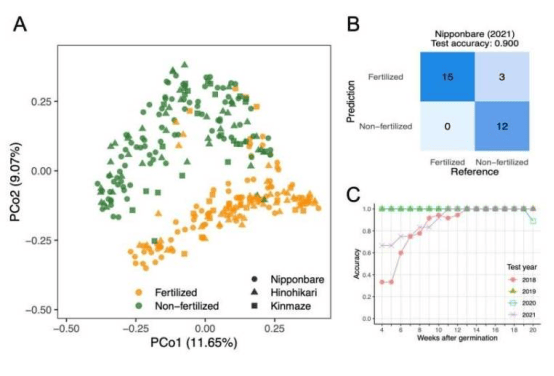
The research team selected an experimental field that has been continuously producing healthy rice crops for more than 70 years without the addition of chemical fertilizers or pesticides, as well as a nearby conventionally fertilized field. Using 16S rRNA gene sequencing technology, they analyzed the microbial DNA in the roots of three Japanese rice varieties (Nipponbare, Hinohikari, and Kinmaze). Samples were collected every two to three weeks throughout the entire growth season, spanning one to four years.
The analysis results showed that microbial diversity in rice roots increases as the plants mature. In the high-yielding, unfertilized field soil, rice roots were enriched with nitrogen-fixing bacteria, which can convert atmospheric nitrogen into forms usable by plants, effectively compensating for the lack of fertilizer. Additionally, anaerobic bacteria dominated during the early vegetative growth stage, while aerobic and microaerophilic bacteria became dominant during the reproductive and maturation stages—this pattern may reflect the typical practice of draining water during developmental transitions in rice cultivation.
These findings provide valuable insights into the accumulation and function of beneficial microorganisms in rice roots under nutrient-poor soil conditions. Isolating and utilizing these microorganisms could provide strong support for sustainable rice cultivation.
Regarding the possibilities opened by this research, lead researcher Professor Yusuke Saijo stated: "Looking ahead, isolating these beneficial bacteria and using them to create customized microbial consortia holds promise for paving the way toward sustainable rice cultivation."
The research team was led by Professor Saijo and included members from NAIST, the University of Tokyo, Tokyo Institute of Technology, Nagoya University, Tohoku University, and other institutions.