
Researchers at the City University of New York have demonstrated how quantum emitters—nitrogen-vacancy (NV) centers in diamond—interact in unexpected ways with specially designed photonic structures when moved by a scanning tip.
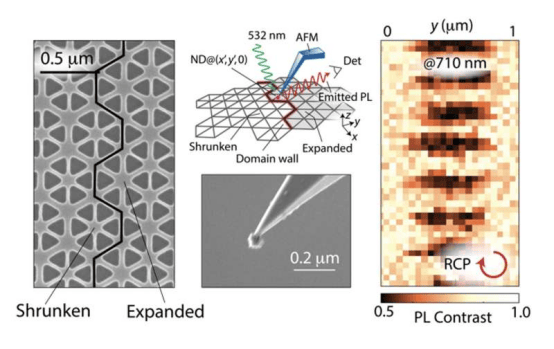
The study, led by Carlos A. Meriles, Martin and Michele Cohen Professor of Physics in the Division of Science, is titled "Topological Photonic Waveguide Modes Emit from Diamond-Shaped Nitrogen-Vacancy Centers" and was published in Nature Nanotechnology.
The long-standing drawback of NV centers—their broad and disordered emission spectrum—has unexpectedly enabled a new type of coupling, reshaping the emitted light in unprecedented ways. This discovery has fundamental implications for quantum information technologies, as the coupling helps overcome long-standing challenges such as spectral diffusion and opens pathways to robust on-chip spin-photon and spin-spin entanglement.
At the same time, the work demonstrates a novel sensing capability: by analyzing NV emission, the team was able to reconstruct detailed, polarization-resolved images of photonic modes with remarkable contrast.
Meriles said: "Beyond photonic structures, this polarization sensitivity could ultimately be applied to detect chiral molecules, which is crucial for biology and medicine."
He added that follow-up research will continue in two directions—deeper exploration of the interaction between quantum emitters and structures, and the development of new sensing applications based on the same principle.