
The Hubble Space Telescope has recently captured the clearest images to date of a comet visiting our solar system from another stellar system at high speed. NASA and the European Space Agency jointly released this latest set of photos on Thursday, providing astronomers with valuable data about the comet.
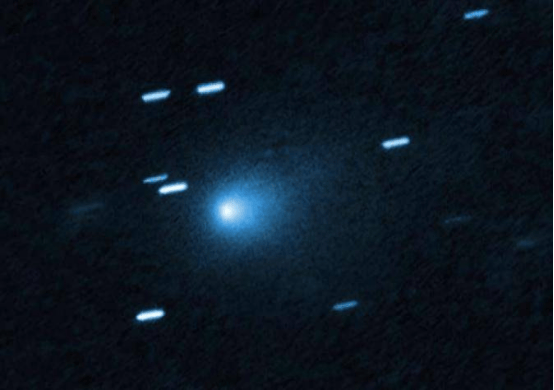
The comet, named 3I-Atlas, was first discovered last month by an observatory in Chile. It is the third known interstellar object to enter our solar system, and fortunately poses no threat to Earth. Astronomers initially estimated the icy nucleus of 3I-Atlas to be several miles (tens of kilometers) wide, but Hubble observations have revised the size downward to no more than 3.5 miles (5.6km), with some scientists suggesting it could be as small as 1,000 feet (320 meters) in diameter.
Comet 3I-Atlas is hurtling through the inner solar system at an astonishing speed of 130,000 miles per hour (209,000km/h). However, it will not pass directly near Earth; instead, it will alter its trajectory when approaching Mars, maintaining a safe distance from both Earth and Mars. When Hubble imaged it, the comet was still 277 million miles (446 million km) away from us. The images clearly show a teardrop-shaped dust column surrounding the nucleus and a long dust tail, providing important clues for scientists studying the comet's composition and behavior.