
Rice University scientists have discovered that microscopic wrinkles in two-dimensional materials can enable precise control of electron spin, opening a new path for developing more compact and energy-efficient electronic devices. The research focuses on the intersection of strain engineering in 2D materials and spintronics properties.
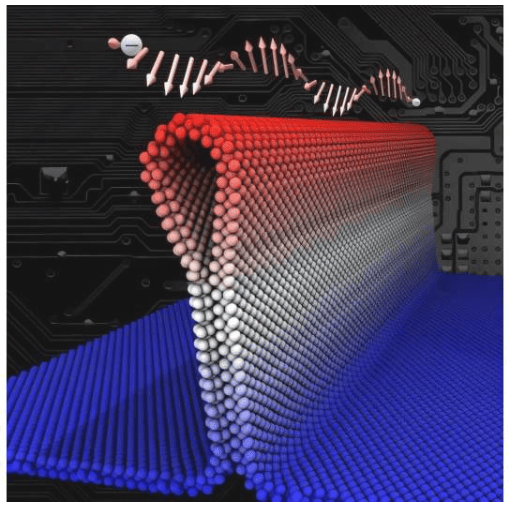
Currently, most electronic devices rely on electron charge for information processing, while spintronics technology seeks to encode information using the spin property of electrons (up or down). This approach holds promise for overcoming the energy-efficiency bottleneck of current silicon-based technology and reducing power consumption in computing devices. However, spin information in materials is easily attenuated due to electron scattering, posing a major challenge for technological development.
In the latest study published in the journal Matter, the Rice University team found that two-dimensional materials such as molybdenum ditelluride, when forming wrinkles, generate a special spin structure known as persistent spin helix (PSH). This structure effectively maintains the spin state, making it difficult to lose information even in the presence of electron scattering. First author Sunny Gupta stated: "In materials with the PSH state, the spin state remains unchanged. Such materials are extremely rare in nature and difficult to prepare."
Led by materials scientist Boris Yakobson, the research team proposed a theoretical hypothesis: the strain inhomogeneity induced by wrinkles in 2D materials triggers flexoelectric polarization effects, resulting in an internal electric field. The higher the curvature, the stronger the spin-orbit interaction. In regions of extremely high curvature, spins exhibit a regular helical texture and complete spin flipping within approximately 1 nanometer scale. Gupta noted: "We confirmed that hairpin-like wrinkles in molybdenum ditelluride can achieve a spin precession length of about 1 nanometer, which is the shortest reported to date." A shorter precession length facilitates the design of more compact spintronic devices.
The study demonstrates the feasibility of manipulating quantum behavior through strain engineering in 2D materials. Yakobson stated: "Mechanical deformation of 2D materials can generate unique field distributions, thereby inducing special spin textures." Gupta added: "The combination of geometric deformation and quantum effects opens a new design dimension for spintronics."