
In the quest to explore signs of life on Mars and the Moon and to identify ideal locations for human bases, scientists are turning their attention to underground lava tubes. To verify the feasibility of this exploration approach, scientists conducted tests on three autonomous robots inside a lava cave on Lanzarote Island, Spain. Lava tubes, deep underground cavities formed by volcanic activity, are widely distributed on Earth as well as on the surfaces of Mars and the Moon. Their unique structures can effectively shield against extreme temperatures, radiation, meteorite impacts, and other harsh space environments, making them considered potential sites for the origin of life and ideal locations for crewed bases.
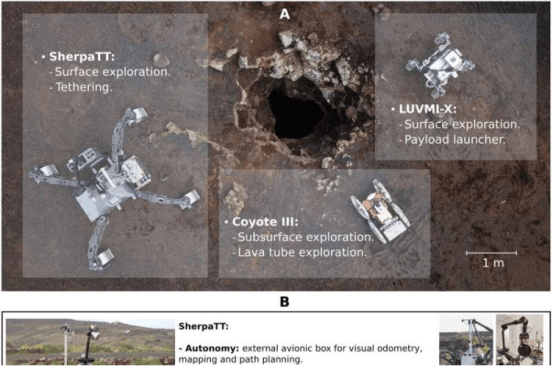
Given the high risks and costs associated with direct human exploration of lava tubes, robots offer a safer and more economical alternative. In a paper published in the journal Science Robotics, the researchers stated: "Heterogeneous collaborative robot teams provide a promising solution to the challenges of accessing and exploring extraterrestrial lava caves." During a 21-day field test, the robot team completed four phases of tasks in a real lava cave environment. First, two rovers mapped the surface terrain around the cave entrance. Then, one rover deployed sensor-equipped cubes to construct a 3D model of the entrance. The most challenging phase involved autonomous collaboration between two robots: a smaller rover connected to a larger rover descended along a rope, reaching a depth of 235 meters into the cave and creating a 3D map.
Although the test was successful, robot exploration of lunar or Martian lava tubes still faces numerous challenges. Moisture in the test environment affected the performance of ground-penetrating radar, sensor interference and the lack of real data limited mapping efforts, and fully autonomous navigation inside the cave remains a major difficulty. Nevertheless, this research undoubtedly brings humanity one step closer to exploring extraterrestrial habitable sites and searching for life in the solar system.