
Quantum computers represent a key emerging technology, particularly suited for solving specific problems that require immense computational power. However, integrating quantum systems into existing supercomputers poses a significant challenge.
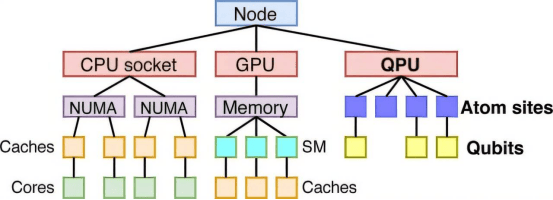
Researchers at the Technical University of Munich (TUM) have developed a tool that combines quantum computers with supercomputers, enabling seamless interaction between them. The approach has been experimentally validated in collaboration with a team from the Leibniz Supercomputing Centre (LRZ).
Quantum computers operate using qubits. Unlike classical bits, qubits can exist in multiple states simultaneously through superposition. Additionally, qubits can become entangled, enabling new computational paradigms that outperform classical systems on certain tasks. However, quantum computers are not universally applicable and are not intended to replace traditional high-performance computing (HPC). Instead, they are envisioned as complementary accelerators within the HPC domain.
Due to differences in architecture, interfaces, and control mechanisms, integrating quantum systems into HPC environments is highly complex. "By developing the hybrid tool named sys-sage, we have addressed some of these challenges," said Martin Schulz, Professor of Computer Architecture and Parallel Systems at TUM and a member of the LRZ Board.
Bridging the Gap: The sys-sage Library
The sys-sage library was originally developed as a central interface for supercomputers. It collects and organizes both dynamic and static information about computer system architectures and topologies, making this information available to applications or other system components.
Architecture describes the fundamental structure of a computer, while topology shows how components are connected physically and logically. In a sense, it can be viewed as a map of the system.
The extension of the sys-sage library proposed in this study now enables a unified representation of the system topologies of both quantum computers and high-performance computers. This creates a hybrid structure that connects the two systems through a unified interface, allowing them to be used together.
Sys-sage then informs other software components, enabling them to execute tasks more efficiently and thereby optimizing the overall system. For example, it supports selecting whether a task should run on the quantum system or the classical system based on its computational characteristics, or mapping problems to the most suitable resources within the respective topology.
Schulz added: "As part of the Munich Quantum Valley initiative and the Munich Quantum Software Stack (MQSS), we have developed this architecture to lay the foundation for the efficient use of quantum computers in supercomputing centers."