
A collaborative research team from the University of Groningen and the University of Amsterdam in the Netherlands has developed a novel type of upconversion nanoparticle that converts near-infrared light into ultraviolet or blue light, thereby effectively driving molecular motors. The study was jointly conducted by Professor Ben Feringa from the University of Groningen, Professor Hong Zhang from the University of Amsterdam, and their PhD student Kefan Wu. The results were published last month in the Journal of the American Chemical Society.
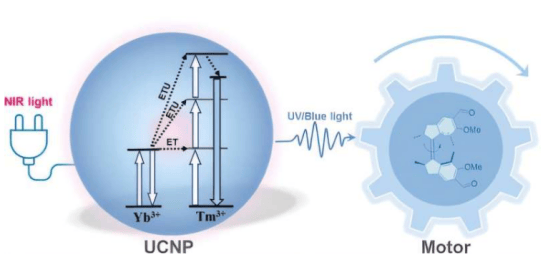
Molecular motors have broad applications in materials science and biomedicine, but their traditional driving relies on ultraviolet or blue light irradiation, which suffers from limited tissue penetration and risks of damage to biological tissues. The research team constructed a light energy transfer system by using lanthanide-doped sodium yttrium fluoride nanoparticles that efficiently convert near-infrared light into ultraviolet/visible light, providing a new solution to overcome the application bottlenecks of molecular motors.
Professor Hong Zhang stated: "Upconversion nanoparticles serve as nanoscale sensors that enable efficient transfer of radiant energy without requiring complex chemical modifications to the molecular motors." Experiments demonstrated that the system's driving effect on molecular motors is comparable to direct ultraviolet light irradiation while significantly improving biocompatibility and material penetration.
This technology is particularly suitable for biological environments and solid material systems, achieving deep light penetration while ensuring low phototoxicity. Dr. Kefan Wu pointed out: "This method exhibits high versatility, creating new possibilities for the practical application of molecular machines in smart materials and biomedical fields."
The research team indicated that this breakthrough will promote the development of dynamic responsive materials and precise medical applications, providing technical support for future designs of biological switches and controllable drug release systems.