
A new study led by the Southwest Research Institute (SwRI) has confirmed a magnetic reconnection theory model proposed decades ago. Magnetic reconnection is the process that releases stored magnetic energy to drive solar flares, coronal mass ejections, and other space weather phenomena. The data were obtained by NASA's Parker Solar Probe (PSP), the only spacecraft to have flown through the Sun's upper atmosphere.
Magnetic reconnection refers to the breaking and reconnection of magnetic field lines in plasma in a new configuration, releasing large amounts of stored energy. On the Sun, this energy release often leads to solar activity that affects technology on Earth, a phenomenon known as space weather. Accurate modeling of solar magnetic reconnection could help predict coronal mass ejections, solar flares, and other space weather events that may impact Earth's satellites, communication systems, and even power grids.
"Reconnection operates on different spatial and temporal scales, in space plasma from the Sun to Earth's magnetosphere, from laboratory environments to cosmic scales," said Dr. Ritesh Patel, a research scientist in SwRI's Department of Solar System Science and Exploration in Boulder, Colorado, and lead author of a new paper published in Nature Astronomy.
Since the late 1990s, we have been able to identify reconnection in the corona through imaging and spectroscopy. With missions such as NASA's Magnetospheric Multiscale (MMS), in-situ detection in Earth's magnetosphere became possible. However, similar coronal studies only became feasible after NASA's Parker Solar Probe launched in 2018.
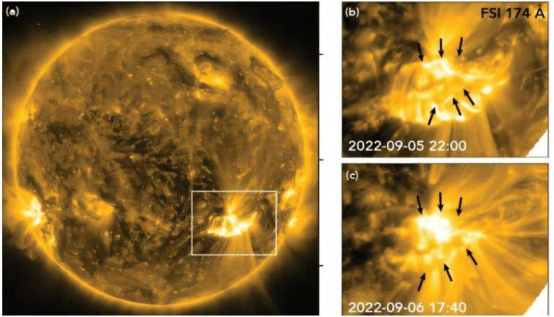
PSP's record-breaking close approaches to the Sun provided new opportunities for research. A close approach on September 6, 2022, revealed a large-scale eruption, offering the first chance for detailed imaging and sampling of plasma and magnetic field properties. The SwRI-led research team combined imaging and in-situ diagnostics with complementary observations from the European Space Agency's Solar Orbiter, confirming that PSP flew through a reconnection region in the solar atmosphere for the first time.
Patel said: "We have been studying magnetic reconnection theory for nearly 70 years, so we have a basic understanding of how different parameters behave. The measurements and observations obtained during this encounter validate numerical simulation models that have existed for decades with some uncertainties. These data will provide strong constraints for future models and offer a pathway to interpret solar measurements made by PSP in other time frames and events."
NASA's MMS mission, led by SwRI, provided researchers with insights into how magnetic reconnection occurs on smaller scales in near-Earth environments. The 2022 PSP observations now provide the missing link connecting reconnection at Earth scales and solar scales. SwRI is now working to determine whether reconnection mechanisms accompanied by magnetic field turbulence or fluctuations exist in the active reconnection regions identified by PSP.
Patel said: "Ongoing research provides discoveries at different scales, allowing us to understand how energy is transferred and particles are accelerated. Understanding these processes on the Sun helps improve predictions of solar activity and deepens our understanding of the near-Earth environment."