
A research team from the Korea Advanced Institute of Science and Technology (KAIST) has successfully developed a novel self-powered photodetector that operates without an external power source under illumination, achieving a sensitivity more than 20 times higher than existing technologies. This breakthrough provides new possibilities for battery-free precise sensing in fields such as wearable devices, IoT sensors, and autonomous driving systems.
Led by Professor Jay-Young Lee from the School of Electrical Engineering, the research team innovatively adopted "van der Waals bottom electrodes" and "partial gating" techniques to successfully overcome the technical challenge of traditional doping processes being difficult to apply to the two-dimensional semiconductor molybdenum disulfide (MoS₂) due to its extreme thinness. The research results have been published in the journal Advanced Functional Materials.
The team's new device structure forms a PN junction without requiring a doping process. This structure enables unidirectional current flow under illumination, serving as the core component for photodetectors and solar cells. The van der Waals electrodes gently adhere to the semiconductor surface via van der Waals forces, preserving the pristine crystal structure of the 2D material while ensuring effective electrical signal transmission. The partial gating technique applies electrical signals to specific regions of the 2D semiconductor, realizing p-type characteristics on one side and n-type on the other.
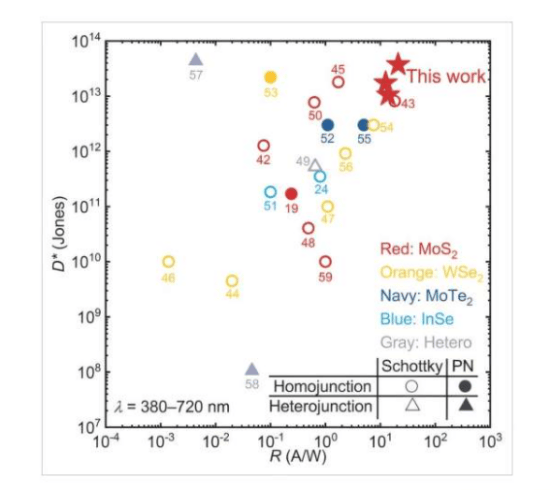
This innovative design allows the new photodetector to maintain extremely high sensitivity even without an external power supply. Test data show that the device's photoresponsivity exceeds 21A/W—20 times higher than conventional powered sensors, 10 times higher than silicon-based self-powered sensors, and more than twice that of existing MoS₂ sensors.
Professor Jay-Young Lee stated: "We have achieved sensitivity levels unimaginable with silicon sensors. Although 2D semiconductors are too thin for traditional doping processes, we successfully created a PN junction that controls current without doping." He added: "This technology is not only applicable to sensors but can also be used for key components in controlling internal power in smartphones and electronic devices, laying the foundation for miniaturization and self-powering in next-generation electronics."
This technological breakthrough opens a new pathway for developing high-precision sensing devices without batteries, with expected wide applications in biosignal monitoring, environmental perception systems, and next-generation electronic devices.