
Quantum computers are attracting significant attention for their ability to tackle challenging problems in physics, chemistry, and other fields. Their core lies in the use of a large number of qubits. Unlike classical bits, qubits possess superposition, allowing them to exist in multiple states simultaneously. This property gives quantum computers a clear advantage in performing complex computations, but it also exposes the fragility of qubits. To compensate for this weakness, researchers are working to build quantum computers with additional redundant qubits to enable error correction—this is why powerful quantum computers will require hundreds of thousands of qubits.
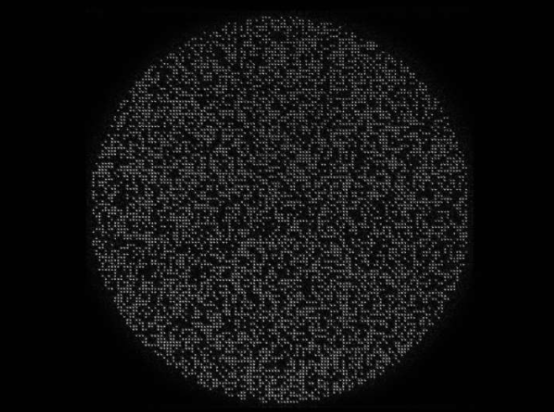
Recently, physicists at the California Institute of Technology achieved a major advancement in this field by successfully creating the largest qubit array to date, trapping 6,100 neutral-atom qubits in a grid using lasers. This milestone marks an important step toward scaling quantum computers, as previous similar arrays contained only hundreds of qubits. The research was led by Professor Manuel Endres, with three graduate students—Hannah Manetsch, Yuko Nomura, and Eli Bataille—playing leading roles in the experimental work.
The team used optical tweezers to trap thousands of individual cesium atoms in a grid, constructing the atomic array. Experiments demonstrated that even with more than 6,000 qubits in the array, the researchers could maintain them in superposition for approximately 13 seconds while manipulating individual qubits with 99.98% accuracy. Furthermore, the team proved that atoms could be moved hundreds of micrometers within the array while preserving superposition—a critical capability for implementing efficient quantum error correction.
"Quantum computers must encode information in a way that tolerates errors," said Bataille. "Our work shows that neutral atoms are a strong candidate for achieving quantum error correction." Looking ahead, the researchers plan to connect qubits in the array in entangled states, allowing particles to become correlated with one another, thereby enabling full-scale quantum computing capable of simulating natural phenomena.