
Using NASA's James Webb Space Telescope, a research team led by the Southwest Research Institute (SwRI) discovered a previously unknown small moon orbiting Uranus during observations on February 2, 2025, increasing the known number of Uranus moons to 29. This discovery not only adds a new member to the Uranus moon family but also provides fresh clues for studying the evolution of planetary systems.
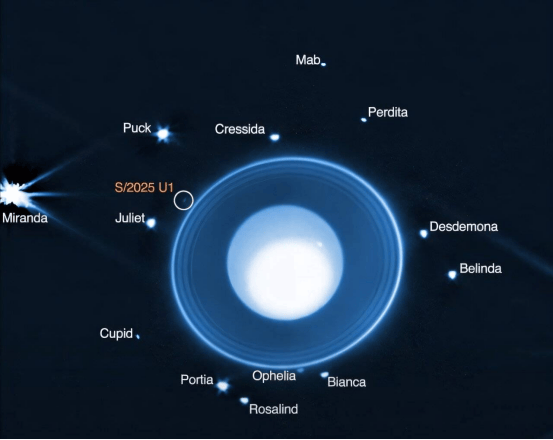
"This object was captured in ten 40-minute long-exposure images taken by the Near-Infrared Camera (NIRCam)," said Maryame El Moutamid, Principal Scientist in SwRI's Department of Solar System Science and Exploration. "Despite its tiny size, this discovery is significant—even NASA's Voyager 2 spacecraft, which flew past Uranus nearly 40 years ago, failed to detect it." The newly discovered moon is estimated to have a diameter of only 6 miles (10km), and its small size and low reflectivity are likely the reasons it remained undetected until now.
Matthew Tiscareno, a member of the research team from the SETI Institute, noted: "Uranus has a large number of inner moons, with complex interactions between them and the rings, suggesting a turbulent history. The discovery of this new moon further reveals the complexity of the Uranus satellite system." The new moon is located between the orbits of Ophelia and Bianca, outside Uranus's main ring system, and its nearly circular orbit indicates it likely formed near its current position. The moon's official naming awaits approval from the International Astronomical Union (IAU).
The James Webb Space Telescope's "General Observer" program provides scientists worldwide with opportunities to use its cutting-edge instruments to explore the universe. NIRCam's high resolution and infrared sensitivity enable it to detect faint, distant objects that were previously difficult to observe with other observatories. This discovery not only highlights the Webb Telescope's potential in solar system exploration but also demonstrates how modern astronomy continues and surpasses past missions, such as Voyager 2's first close-up observation of Uranus in 1986.