
A joint research team from the Technion – Israel Institute of Technology and the University of Texas at Austin has made new progress in studying the structure of seawater desalination membranes. The results were published in ACS Nano and selected as the cover article. The study is the first to systematically analyze the structural characteristics of membranes in the hydrated state, revealing significant differences compared to the dry state. This finding provides important reference value for improving the efficiency of seawater desalination and water purification technologies.
The research was led by Dr. Tamar Segal-Peretz from the Wolfson Department of Chemical Engineering at the Technion, Dr. Guy Ramon from the Faculty of Civil and Environmental Engineering at the Technion, and Professor Manish Kumar from the Walker Department of Mechanical Engineering at the University of Texas at Austin. Other contributors included PhD student Chenhao Yao (University of Texas at Austin) and Dr. Adi Ben-Zvi, who completed the research during her PhD in Nanoscience and Nanotechnology at the Technion and is now a postdoctoral researcher at Rice University.
Clean water is listed as a key issue in the United Nations Sustainable Development Goals, making seawater desalination and water reuse technologies widely recognized, especially in arid regions. In Israel, for example, approximately 70% of household water currently comes from five seawater desalination plants, and about 85% of wastewater is treated and reused for agricultural irrigation.
Reverse osmosis, the mainstream seawater desalination technology, relies on special thin membranes to separate salt and impurities, with membrane performance directly affecting freshwater output efficiency and cost. However, these membranes are extremely thin and complex, making it difficult for traditional characterization methods to accurately capture their real structure in the actual working state—that is, the hydrated state.
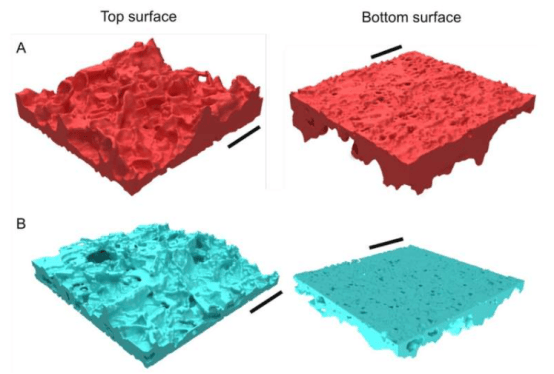
This study used low-temperature transmission electron microscopy tomography to perform high-resolution three-dimensional imaging of reverse osmosis membranes in a fully hydrated state for the first time. The results show that the membrane volume expands by more than 30% in the hydrated state, with significant structural changes—a phenomenon not observed in previous characterizations under dry conditions. This difference provides new directions for understanding the actual working mechanism of membranes and optimizing their performance.
The researchers noted that this discovery is expected to promote the design and development of next-generation high-efficiency reverse osmosis membranes, further enhancing the practicality and sustainability of seawater desalination and water reuse technologies.