
An international research team has obtained the first direct evidence of small-scale torsional Alfvén waves in the solar corona using the world's leading solar observation instruments. The breakthrough results, published in Nature Astronomy, are expected to help solve the long-standing scientific mystery of why the outer solar atmosphere is far hotter than its surface.
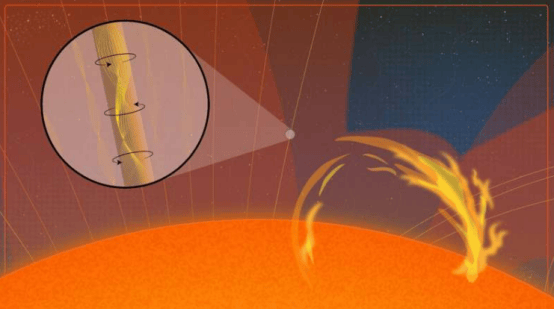
This groundbreaking discovery was made possible by the Daniel K. Inouye Solar Telescope (DKIST), funded by the U.S. National Science Foundation and located in Hawaii. Equipped with a four-meter mirror, this observatory successfully captured subtle twisting motions of magnetic fields in the corona through its cryogenic near-infrared spectro-polarimeter. Lead researcher Professor Richard Morton from Northumbria University in the United Kingdom stated: "Our innovative analysis method successfully separated different types of wave signals, ultimately allowing us to directly observe these persistent Alfvén waves twisting magnetic field lines back and forth in the corona."
Scientists have been searching for Alfvén waves—magnetic disturbances that transmit energy through plasma—since the 1940s. The small-scale persistent waves discovered in this study differ markedly from the isolated large-scale waves previously observed during solar flares. Professor Morton added: "This discovery provides critical validation for theoretical models describing how Alfvén wave turbulence drives the solar atmosphere."
The specialized analysis technique developed by the research team successfully isolated torsional motion signals from dominant oscillatory motions. By detecting characteristic redshifts and blueshifts on either side of magnetic structures through spectral analysis, the researchers ultimately confirmed the presence of Alfvén waves. This achievement will advance the in-depth exploration of coronal heating mechanisms and have a positive impact on improving space weather forecasting models.