
Researchers at Kiel University have developed innovative carrier particles manufactured using high-precision 3D printing technology, significantly enhancing the drug delivery efficiency of dry powder inhalers. The research was led by Professor Regina Scherließ's team, and the results were published in the journal Communications Materials.
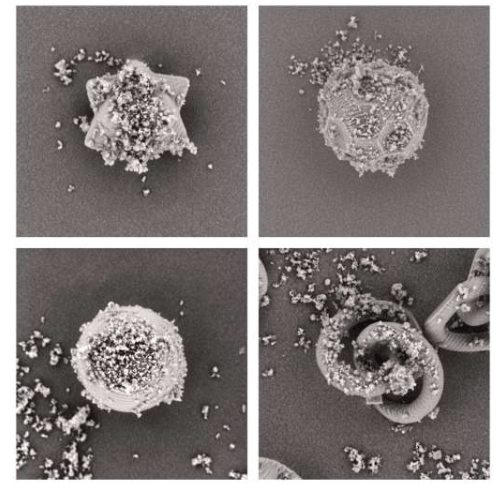
Using two-photon polymerization technology, the research team fabricated four types of micro-carrier particles with precise geometric shapes. This nanoscale-resolution printing process was further optimized by the Karlsruhe Institute of Technology, enabling efficient simultaneous production of 49 structures. For each design, the team produced more than 2 million particles with consistent shapes and combined them with model drugs.
Experimental results showed that the geometric morphology of the carrier particles has a decisive influence on drug delivery performance. Among them, the star-shaped structure named "Pharmacone" performed outstandingly, with its fine particle fraction four times higher than the next-best design. Melvin Vostry stated: "The multiple protruding tips of this geometric shape increase inter-particle collisions and rotation, promoting effective drug detachment."
The study also found that surface roughness of the particles had no significant impact on drug release. These 3D-printed carrier particles are currently used only for fundamental research but provide a new direction for future drug delivery system development. Professor Scherließ noted: "High-resolution 3D printing technology opens new avenues for drug development, allowing precise control of drug behavior through micrometer-scale design."