
A German research team from Bochum and Regensburg has made new discoveries in the study of algal ion channels, providing important scientific basis for the future development of optogenetics technology. The study focused on the photosensitive ion channel GtACR1 from the alga Guillardia theta, revealing its unique light-activation properties.
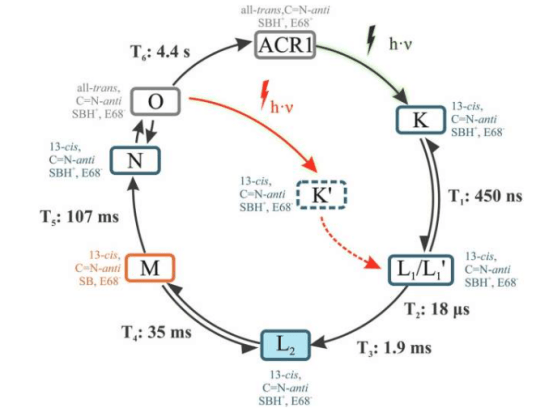
Using Fourier transform infrared spectroscopy, the researchers discovered for the first time that the GtACR1 ion channel has two light-activated states: the traditional ground state and a novel O-intermediate state. This dual-state mechanism allows the ion channel to reopen quickly after closing, significantly improving ion conductance efficiency. Optogenetics research relies on the light-control capability of neuronal cells, and this discovery provides a new optimization direction for the technology.
Till Rudack, professor at the University of Regensburg and representative of the research team, said: "When light hits these proteins, they change their structure, thereby activating or inhibiting cells." Carsten Kötting, associate professor at Ruhr University Bochum, added: "Optogenetics is a very promising new method. For example, it can be used to treat Parkinson's disease. It can reactivate damaged neuronal cells in the brain and partially restore motor skills."
Compared with other channelrhodopsins, GtACR1 can directly activate its O-intermediate state through light irradiation due to differences in retinal configuration. Dr. Kristin Labudda from the Department of Biophysics at Ruhr University Bochum emphasized: "The second light-activated state we discovered ensures that the channel can reopen very quickly, thereby significantly increasing its ion conductance." Higher ion conductance means that optogenetic operations can achieve more precise cell targeting and stimulation response.
The research results were published in the journal Communications Biology, providing new ideas for the optimization of optogenetics technology. Associate Professor Kötting summarized: "Through our research, we have discovered for the first time a channelrhodopsin with multiple light-activated states. It should be possible to create more light-activated states in other channelrhodopsins through mutations, thereby improving their effectiveness." These advances will promote the application research of optogenetics in the field of medical treatment.