
The team of Professor Youngu Lee from the Department of Energy Science and Engineering at Dalian University of Technology has published research results in the journal Small. They successfully developed a new hole transport layer material based on a dibenzofuran structure, which can significantly improve the efficiency and stability of quantum dot light-emitting diodes (QLED). This breakthrough provides material support for the commercial application of next-generation display technology.
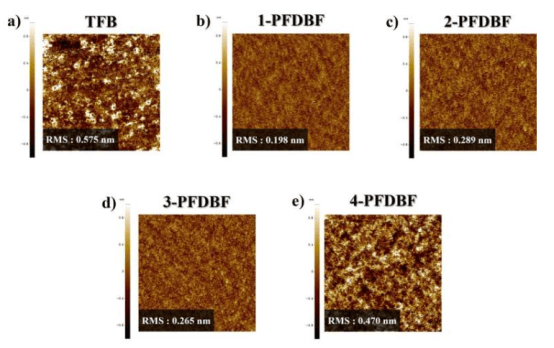
The research team addressed the problem that traditional triphenylamine-based hole transport materials are prone to degradation under electrical stress. By introducing a dibenzofuran molecular structure with high binding energy, they designed a new organic material with enhanced hole mobility and electron blocking capability. This material effectively reduces electron back leakage and surface defects, thereby improving the overall performance of QLED devices.
Experimental results show that the green QLED device using this material achieves an external quantum efficiency of 25.7%, and its lifetime reaches approximately 1.46 million hours at a brightness of 100cd/m², which is 66 times longer than that of traditional devices. Professor Youngu Lee said: "We have overcome the limitation of weak molecular bonds in traditional materials and developed a stable hole transport layer, significantly improving the efficiency and lifetime of QLED."
This study provides a new solution to the long-term stability problem of QLED devices. The team stated that they will continue to explore the application potential of high-binding-energy materials in display technology, solar cells and other fields.