
As an emerging technology, quantum computers demonstrate unique advantages in solving specific compute-intensive problems. However, integrating them into existing supercomputer systems still faces challenges. Recently, a collaborative team from the Technical University of Munich (TUM) and the Leibniz Supercomputing Centre (LRZ) successfully developed a hybrid tool named sys-sage, achieving seamless interaction between quantum computers and supercomputers. This breakthrough introduces a new type of accelerator to the high-performance computing (HPC) field, significantly improving computational efficiency for complex tasks.
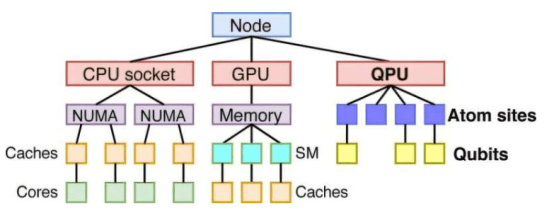
Quantum computers achieve superposition and entanglement through qubits, surpassing classical systems in specific tasks. However, their architecture and interfaces differ from traditional HPC, resulting in significant integration difficulties. "With the sys-sage tool, we have addressed some of the technical challenges," said Professor Martin Schulz, Chair of Computer Architecture and Parallel Systems at TUM and a member of the LRZ Board. The tool was initially designed as a central interface for supercomputers, capable of dynamically collecting and organizing system architecture and topology information to provide unified data support for applications. In this study, the sys-sage library was extended to simultaneously represent the system topologies of both quantum computers and high-performance computers, forming a hybrid architecture and enabling collaborative operation of the two systems through a unified interface.
Specifically, the sys-sage library provides a "map" of the system, allowing software components to select the optimal computing resources based on task characteristics. For example, it can automatically determine whether a task is better suited for the quantum system or the classical system, or map the problem to the best node in the corresponding topology, thereby optimizing overall performance. Martin Schulz added: "As a core component of the Munich Quantum Valley initiative and the Munich Quantum Software Stack (MQSS), sys-sage lays the technical foundation for the efficient use of quantum computers in supercomputing centers."