
An international research team involving the University of Jyväskylä in Finland has made progress in the field of superconducting control technology by developing a new method that can completely suppress superconductivity in superconducting and ferromagnetic structures. The research results have been published in the journal Nature Communications. This achievement holds positive significance for advancing the development of non-volatile superconducting random-access memory and may bring higher energy-efficiency solutions to information and communication technology.
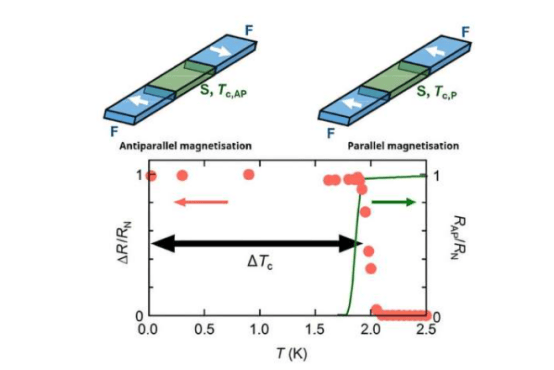
Superconductivity refers to the special state in which a material's electrical resistance approaches zero below a critical temperature. A superconducting switch mechanism enables the on/off control of the superconducting state through external means, functioning similarly to a switch that interrupts current in a circuit. Current research is based on a theoretical model proposed by physicist Pierre-Gilles de Gennes in 1966, which suggested a pathway to regulate the critical temperature of a superconductor by controlling the magnetization direction of a ferromagnetic layer.
Alberto Hijano, a postdoctoral researcher at the University of Jyväskylä, stated: "Although existing structures have demonstrated the sensitivity of the superconducting critical temperature to magnetization direction, the actual magnitude of change in the critical temperature has always been lower than theoretically expected." The research team achieved complete suppression and controllable switching of superconductivity by using europium sulfide (EuS) as the insulating ferromagnet, niobium (Nb) as the superconductor, and introducing a gold interlayer to enhance the near-field exchange effect at the interface.
This technological breakthrough lays the foundation for superconducting memory applications. Hijano added: "An absolute superconducting switch will help develop non-volatile superconducting random-access memory. Compared to thermal switches, the magnetically controlled switching mechanism eliminates continuous thermal load, providing a new direction for the development of low-energy electronic devices." The study was jointly conducted by the University of Cambridge, the University of the Basque Country, and the University of Jyväskylä. The results are expected to promote the practical application of superconducting technology in energy-efficient computing.