
Charging a car to full while having a cup of coffee is people's vision for future travel, but current batteries have not yet reached this ideal state. Although modern lithium-ion batteries can charge from 20% to 80% in 20 to 30 minutes, it takes longer to fully charge, and fast charging puts great stress on the battery. However, a new international review study published in the journal Advanced Energy Materials brings hope for lithium-sulfur batteries (LSB) to overcome these limitations.
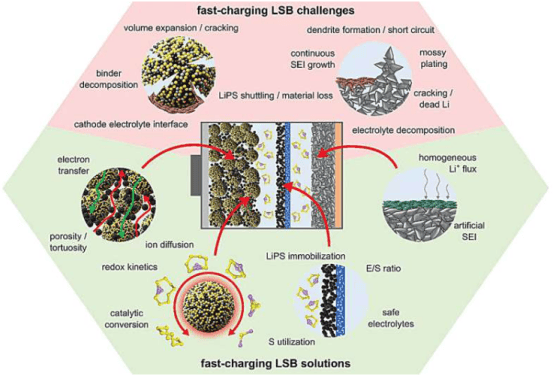
Researchers from Germany, India, and Taiwan, coordinated by Dr. Mozaffar Abdollahifar from Professor Rainer Adelung's research group at Kiel University (CAU), systematically analyzed hundreds of recent studies and identified the mechanisms that enable LSB to operate stably and efficiently at high charging rates. Their goal is to control charging time within 30 minutes (ideally as low as 12 minutes), while achieving higher energy density and longer driving range.
LSB is regarded as a strong alternative to traditional lithium-ion batteries. Lithium-ion batteries store and release lithium ions in solid electrode materials, while LSB relies on chemical reactions that form new compounds, using a combination of metallic lithium anode and sulfur cathode. Theoretically, its energy density can reach 2600Wh per kilogram, about 10 times that of traditional systems, enabling electric vehicles to travel longer distances on a single charge. In addition, sulfur is low-cost, widely available, environmentally friendly, and non-toxic, providing economic reasons for switching to sulfur as the cathode material.
However, the widespread application of LSB still faces technical obstacles. Sulfur is an electrical insulator and needs to be used with conductive additives, which increases battery weight; the cathode volume expansion rate during charge and discharge can reach up to 80%, affecting the mechanical stability and lifespan of the battery; the "shuttle effect" causes soluble lithium polysulfides to migrate to the anode, triggering side reactions that affect efficiency and stability; needle-like dendritic crystals may grow on the lithium metal anode, potentially causing short circuits or even fires.
The study particularly analyzed batteries with extremely fast charging times (starting from 2C, i.e., within 30 minutes) and high sulfur content. The key strategies proposed for this include: in cathode design, using conductive carbon structures such as nanotubes, graphene or activated carbon to improve ion transport and sulfur utilization, and carbon materials rich in defects and doping to reduce the shuttle effect; using catalytic materials such as metal oxides, chalcogenides or single-atom catalysts to accelerate sulfur reactions and mitigate the shuttle effect; optimizing separators with functional separator layers to capture polysulfides and promote rapid ion transport; developing new electrolyte systems, high-concentration solid electrolytes and specific additives to enhance conductivity, compatibility with lithium metal and suppress side reactions; constructing stable anodes with 3D lithium structures and artificial interface protective layers to prevent dendrite formation; exploring new forms of sulfur, where monoclinic γ-sulfur enables direct solid-state reactions and completely eliminates the shuttle effect; utilizing artificial intelligence for material development to accelerate material discovery, predict battery performance, and design more efficient and safe charging processes.
"Our analysis shows that fast charging within 30 minutes is feasible while maintaining capacity, and in some cases even less than 15 minutes," Abdollahifar said. "Current prototype batteries have achieved good charging performance of about 2mAh per square centimeter at practical charging speeds. However, to truly surpass existing lithium-ion batteries, further improvements in material loading and performance are still needed."
This study integrates materials science, electrochemistry, nanotechnology and battery engineering to form a comprehensive approach to fast-charging batteries, providing a guideline for developing powerful, durable and safe LSBs. It establishes clear standards and systematic methods, offering a practical roadmap for achieving fast-charging LSBs in mobility and energy storage applications.