
A joint research team from the Korea Institute of Science and Technology (KIST), DGIST, and Yonsei University has successfully developed a new technological approach that utilizes spin loss as a new energy source for magnetic control. The research results have been published in the journal Nature Communications, providing a new path for improving energy efficiency in spintronic devices.
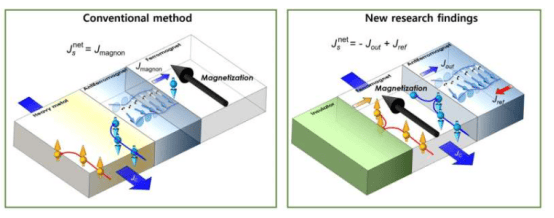
Spintronics technology uses the spin properties of electrons for information storage and processing and is regarded as the core foundation for next-generation ultra-low-power memory and neuromorphic chips. The traditional view holds that spin loss reduces device efficiency, but the team discovered that this loss can actually serve as a new energy source to drive spontaneous reversal of magnetization direction. The research team experimentally demonstrated that the greater the spin loss, the smaller the power required for magnetization switching, resulting in three times higher energy efficiency compared to traditional methods.
Dr. Dong-Soo Han, Chief Researcher at the KIST Center for Semiconductor Technology, stated: "The field of spintronics has long focused on reducing spin loss. We propose a new direction that utilizes loss as the driving energy for magnetization switching." The technology adopts a simple device structure, is compatible with existing semiconductor processes, and offers advantages in scalable production and miniaturization.
This breakthrough technology can be applied in multiple fields such as artificial intelligence semiconductors, ultra-low-power memory, and probabilistic computing devices. In particular, it will provide technical support for the development of high-efficiency computing devices in the fields of artificial intelligence and edge computing. The research team stated that they will continue to advance the development of ultra-small, low-power artificial intelligence semiconductor devices.