
An international research team at the UK's MAST Upgrade facility has successfully tested an innovative exhaust system that reduces the enormous heat load inside a fusion reactor by more than ten times compared to previous designs.
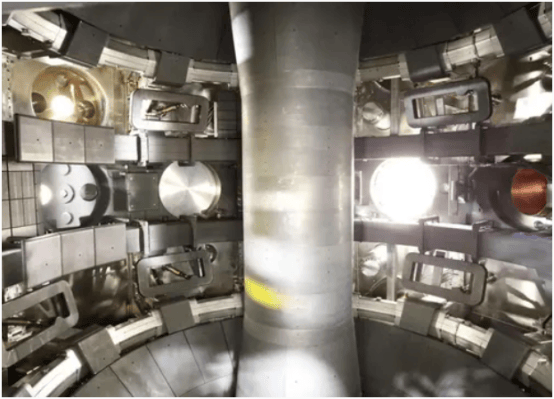
James Harrison, Head of MAST Upgrade Science at the UK Atomic Energy Authority, said: "These results are thanks to the close international collaboration between the UK Atomic Energy Authority, Eindhoven University of Technology, DIFFER, and the EUROfusion team, and will continue to advance our understanding of this important area of research." This key progress directly addresses one of the biggest obstacles to building commercial fusion power plants.
Future fusion power plants will operate under extreme conditions. To generate energy, they must contain plasma (superheated gas of hydrogen fuel) at temperatures higher than the Sun. Researchers state that temperatures exceeding 10,000 degrees Celsius and streams of charged particles from the fusion fuel (plasma) are the extreme conditions that the exhaust walls (divertors) of future fusion power plants must withstand. The design of the divertor, which bears the impact, is a critical engineering challenge for the feasibility of fusion energy.
The brand-new "Super-X" divertor design provides a solution. The system was developed at the MAST Upgrade facility specially built by the UK Atomic Energy Authority (UKAEA) and features longer, more extended exhaust paths. These longer "legs" give the hot plasma more space and time to cool before contacting solid surfaces, greatly reducing heat and pressure on the reactor walls.
Harrison emphasized: "Proving that plasma conditions in the MAST Upgrade divertor can be controlled independently is an important step toward developing powerful control of plasma exhaust in future machines." The latest results have transformed the Super-X concept from a promising theory into a mature technology. According to reports, this is a world first. In the MAST Upgrade project, researchers have demonstrated that the Super-X method can control the exhaust without affecting the opposing divertor or the plasma core that generates fusion energy. This ability to manage the edge without disturbing the core is crucial for stable and continuous operation of power plants.
Researchers also confirmed that the Super-X design is easier to manage than traditional short-leg divertors. The results show that modest design modifications can bring significant benefits and provide engineers with flexibility in designing future reactors. Bob Kool from DIFFER and Eindhoven University of Technology summarized: "These results clearly demonstrate the many advantages of alternative divertors in maintaining acceptable divertor conditions for fusion power plants."
Thermal management has become a key research area in the field of nuclear fusion energy, with researchers around the world working on it. Recently, scientists at the DIII-D National Fusion Facility made new progress. They studied a different tokamak operating method, and experiments showed that a plasma configuration known as "negative triangularity" can achieve the high-performance conditions required to sustain fusion energy. This is the first time researchers have achieved high plasma confinement using a negative triangularity configuration combined with "divertor detachment."