
On August 14, reporters learned from Qingdao University of Science and Technology that Professor Liu Kai from the university has developed the world's first N-type thermoelectric elastomer, known as "thermoelectric rubber," providing a new solution for energy harvesting technology in flexible electronics and wearable devices. The related research results were published in Nature on August 13.
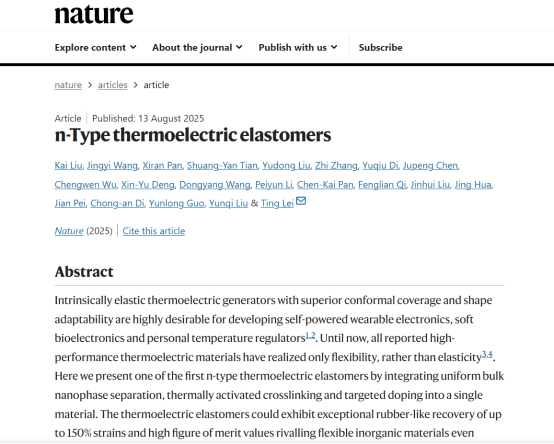
For a long time, traditional thermoelectric devices have mostly used inorganic thermoelectric materials, which focus on applications in rigid structures and lack elasticity and shape adaptability, limiting their use in wearable devices. To address this issue, Liu Kai, relying on the research achievements of Professor Lei Ting's team from Peking University and Professor Hua Jing's team from Qingdao University of Science and Technology, developed an N-type thermoelectric elastomer. This is an innovative material that combines elasticity, stretchability, and thermoelectric conversion capability, opening a new direction for energy harvesting technology in wearable devices.
Liu Kai explained that by combining three strategies — uniform nanophase separation, thermally activated crosslinking, and oriented doping — he successfully synthesized the N-type thermoelectric elastomer. The material exhibits excellent stretchability and resilience, with a tensile strain of up to 850%, comparable to traditional rubber. At the same time, its thermoelectric figure of merit reaches 0.49 at 300 Kelvin, approaching or even surpassing the performance of existing flexible or plastic inorganic thermoelectric materials.
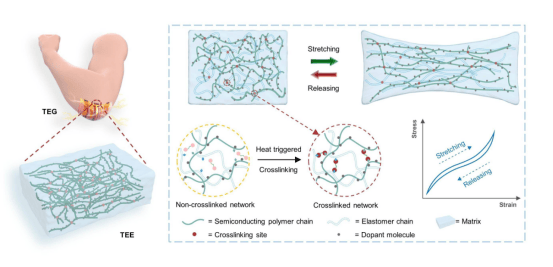
The researchers, through precise selection of the combination of elastomers and dopants, not only improved the stretchability of the material but also promoted the formation of uniformly distributed semiconductor polymer nanofibers, thereby enhancing the electrical conductivity and reducing the thermal conductivity of the material, breaking through the bottleneck that thermoelectric materials could not simultaneously possess high performance and elastic tunability.
Based on this, the researchers fabricated the world's first elastic thermoelectric generator. Unlike inorganic thermoelectric devices, the elastic thermoelectric generator does not require complex interconnection structures and can directly adapt to the skin surface while maintaining a high filling factor and low thermal resistance. The device combines high thermoelectric conversion efficiency with excellent comfort and shape adaptability, demonstrating the potential to power wearable electronic devices and biosensors.