
Relocatable Modular Buildings (RMB) are an innovative and rapidly evolving flexible and sustainable construction solution. They can be quickly assembled from prefabricated "modules" and easily transported, significantly reducing costs and environmental impact while providing a safer and cleaner construction environment. However, in relocatable modular building projects, how to manage assets and modular units so that they can be reused and relocated across multiple life cycles remains a major challenge.
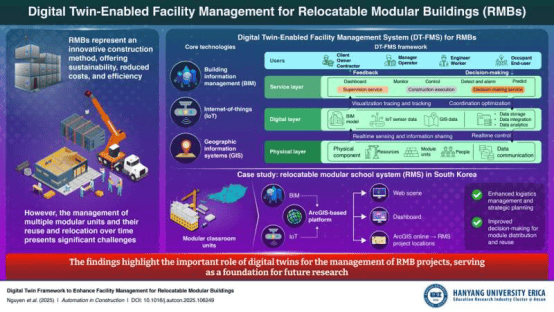
To address this issue, a research team led by Associate Professor Yonghan Ahn from the College of Architecture and Architectural Engineering at Hanyang University ERICA has developed a new digital twin (DT)-based facility management framework for RMB projects.
Professor Ahn explained: "Digital twin technology is a breakthrough tool that provides a digital replica of physical assets and integrates real-time data, predictive analytics, and decision-making capabilities. Although digital twin technology is becoming increasingly popular in other fields, its application in modular construction remains limited. We have introduced a new digital twin facility management system (DT-FMS) specifically tailored for relocatable modular buildings (RMB)." The team's research results were published in the journal Automation in Construction, with Dr. Dennis Nguyen from Hanyang University also contributing to the study.
The new DT-FMS integrates Building Information Modeling (BIM), the Internet of Things (IoT), and Geographic Information Systems (GIS) to create a detailed virtual model of relocatable modular buildings (RMB). The model supports real-time monitoring, performance analysis, and logistics simulation throughout the entire building life cycle. Among them, BIM provides powerful 3D modeling and comprehensive building information; IoT provides real-time sensor data; and GIS provides critical geographic data to support efficient logistics and location-based decision-making for modular units.
The framework consists of three interrelated layers: the physical layer, the digital layer, and the service layer. The physical layer serves as the foundation for real-time tracking and communication between different physical components (such as resources, modular units, and personnel including stakeholders, engineers, and workers); the digital layer contains modeling tools, data integration, and analysis functions; the service layer allows users to monitor, control, and interact with the DT framework, thereby supporting effective decision-making throughout the entire building life cycle.
To demonstrate the practical application of the framework, the researchers conducted a case study on Korea's relocatable modular school system. The results showed that DT-FMS enhanced decision-making for module allocation and reuse, and improved management efficiency.
Dr. Nguyen commented: "Our research highlights the important role of digital twins in promoting the circular economy. It enables the reuse, reconfiguration, and optimal repositioning of modular units, thereby minimizing waste and maximizing value across repeated project cycles."