
Texas A&M University has developed a highly innovative tool called "CLARKE" (Computer Vision and Learning for Roads and Key Buildings Evaluation), a technology that promises to revolutionize the way emergency responders assess post-disaster damage.
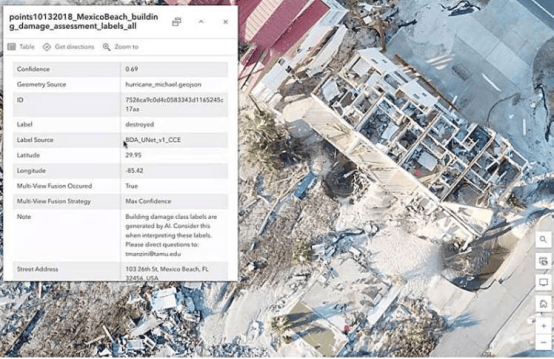
"CLARKE" was created by a research team led by computer science and engineering PhD student Tom Manzini and Dr. Robin Murphy, a pioneer in the field of rescue robotics. It is the first artificial intelligence system capable of classifying damage to buildings and roads from drone imagery at large scale and high speed. The research team's goal is to complete damage assessment for a community of 2,000 households in just seven minutes, in order to save lives and conserve resources.
The system has already proven its value during the 2024 hurricane season. After Hurricanes Debbie and Helene, it was deployed in Florida and Pennsylvania, demonstrating its effectiveness. Its name "CLARKE" is a tribute to science fiction writer Arthur C. Clarke's famous quote, inspired by a drone pilot's amazement at the machine learning capabilities of the system.
From a scientific perspective, there is nothing mysterious about "CLARKE." It uses cutting-edge computer vision and machine learning algorithms to analyze drone-captured images, overlay damage assessments on maps, and generate spreadsheets containing each building's address and level of damage. For roads, it is also equipped with a route planner similar to Google Maps to help rescue personnel avoid impassable sections. Murphy stated that "CLARKE" not only identifies damaged locations but also provides repair recommendations, which is critical in time-sensitive rescue operations.
Under traditional methods, damage assessment in rural or remote areas can take days, delaying aid and increasing logistical difficulties. "CLARKE" allows officials to launch drones and receive a comprehensive damage report within minutes, significantly accelerating response times. Even in rural areas with poor wireless connectivity where images cannot be sent to state and federal agencies for manual review, "CLARKE" enables them to take immediate action.
The system was trained on drone images of more than 21,000 homes from 10 major disasters, including Hurricanes Harvey and Ian. The massive dataset enables it to identify various damage patterns and adapt to different disasters such as hurricanes, floods, and wildfires.
Although the technology itself is groundbreaking, the success of "CLARKE" depends on its users. Last month, Florida State University hosted a "CLARKE" cognitive training course. Originally planned to attract 15 to 20 participants, it ultimately received nearly 100 registrations, highlighting strong interest in AI-driven disaster tools. David Merrick, Director of the Emergency Management and Homeland Security Program at Florida State University and head of the Florida Drone Systems Working Group, spoke highly of the system's capabilities, noting that it is particularly significant for rural counties and helps improve the efficiency and effectiveness of disaster assessment.
The development of "CLARKE" began in 2022, with its creators continuously refining it based on real-world feedback. After its deployment in 2024, in April 2025 the Texas A&M University team participated in a tabletop exercise to gather feedback from rescue personnel. They not only received valuable suggestions but also sparked the need for formal training, ultimately leading to the training event in June.
Murphy believes "CLARKE" has a bright future. It is both a practical tool and a platform for further research. Currently, the research team has identified fundamental and significant limitations in machine learning when processing such images, similar to those found in medical imaging, and plans to further optimize and improve the system in the future.