
Researchers from Arizona State University, King Abdullah University of Science and Technology, and other institutions have developed a new method to synthesize hexagonal boron nitride (hBN) thin films at temperatures compatible with silicon-based CMOS technology, successfully fabricating stable memristive devices. The research results have been published in the journal Nature Nanotechnology.
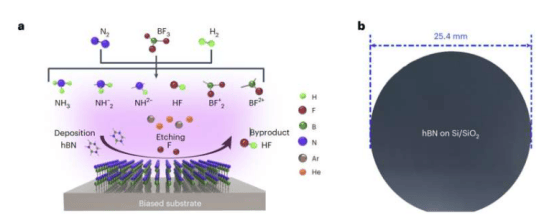
Two-dimensional hexagonal boron nitride has shown great potential in building neuromorphic computing and in-memory computing systems due to its excellent insulating properties and mechanical strength. However, traditional high-temperature synthesis methods are difficult to integrate with CMOS processes, and the transfer process often introduces defects. The research team used electron cyclotron resonance plasma-enhanced chemical vapor deposition (ECR-PECVD) technology to achieve direct deposition of high-quality hBN thin films at temperatures below 380°C.
The polycrystalline hBN thin films prepared by this method exhibit excellent wafer-scale uniformity and can be integrated with existing electronic devices without the need for transfer. Memristors fabricated based on this thin film demonstrate high yield (approximately 90%), stable multi-state operation capability (more than 16 states), and excellent endurance. The researchers stated: "We directly integrated the memristors into an industrial CMOS test platform, achieving millions of programming cycles. This marks an important step toward wafer-scale integration of hBN memristors."
This breakthrough provides a new pathway for the integration of two-dimensional materials with existing semiconductor technologies and is expected to promote the development of high-performance computing devices. The research team indicated that the method is also applicable to the low-temperature synthesis and integration of other two-dimensional materials.