
Temperatures exceeding 10,000°C and "hailstorms" of charged particles from fusion fuel (plasma) are the extreme conditions that the exhaust walls (divertors) of future fusion power plants must withstand. Managing the exhaust flow has therefore become one of the main challenges in achieving clean, safe, and economically viable commercial fusion power plants.
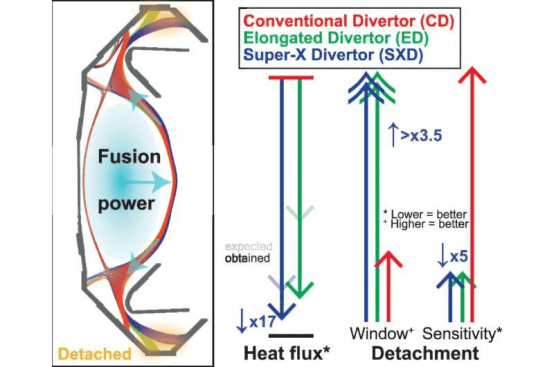
Previous proof-of-concept studies showed that the "Super-X" divertor design can reduce heat loads by more than a factor of ten compared to conventional designs. Now, new experimental results have elevated these initial observations to proof-of-concept level, demonstrating its key advantages for fusion power plants: enhanced power exhaust control while balancing engineering complexity.
The UK's national fusion experiment, the MAST Upgrade project, built by the UK Atomic Energy Authority (UKAEA), aims to develop solutions for power exhaust in nuclear fusion. Its Super-X design originated from a concept at the Institute for Fusion Studies at the University of Texas at Austin. It features a longer divertor and longer plasma "legs," providing more space for cooling the plasma before it strikes the divertor wall.
This new result is a world first. In the MAST Upgrade project, researchers demonstrated that the Super-X approach achieves exhaust control without affecting the opposite divertor or the plasma core that generates fusion energy. It also showed that the Super-X configuration is easier to control under the gentler conditions required compared to traditional designs. This strengthens confidence in finding suitable exhaust solutions for fusion power plants. Previous studies had already indicated that the Super-X configuration in MAST Upgrade helps combine a hot plasma core with cold conditions in the divertor.
The experiments further demonstrated that even modest modifications to the divertor legs compared to the traditional "short-leg" design can bring significant advantages in controlling fusion heat, consistent with computer model predictions and showing improved understanding of divertor design. Future fusion projects are expected to benefit from significantly improved divertor conditions and exhaust control while balancing engineering complexity.
The physics and engineering results of the Super-X divertor were published in the journals Communications Physics and Nature Energy. Dutch fusion researchers Kevin Verhaegh (formerly at the UK Atomic Energy Authority, now at Eindhoven University of Technology) and Bob Kool (from the Dutch research institute DIFFER and Eindhoven University of Technology) led the study in collaboration with the UK Atomic Energy Authority and the European EUROfusion research team. The research builds on collaborative achievements in the divertor field, such as experiments conducted on the Swiss fusion machine TCV.
Verhaegh from the Nuclear Fusion Science and Technology research group at Eindhoven University of Technology stated that these results bode well for future projects such as the UK's STEP fusion machine, the U.S. ARC fusion machine, and Europe's DEMO fusion machine. They demonstrate that modest but strategic modifications to the divertor can deliver many of the benefits of more extreme divertor geometries, opening new pathways for improving the design of future fusion machines.
Kool, head of the Control Systems Technology research department at DIFFER and Eindhoven University of Technology, said these results clearly show that alternative divertors offer numerous advantages in maintaining acceptable divertor conditions for fusion power plants. This is an important step toward solving the exhaust problem and brings us closer to realizing fusion energy.
James Harrison, MAST Upgrade Science Lead at the UK Atomic Energy Authority, stated that demonstrating independent control of plasma conditions in the MAST Upgrade divertor is an important step toward developing powerful control of plasma exhaust in future machines. These results, made possible by strong international collaboration between the UK Atomic Energy Authority, Eindhoven University of Technology, DIFFER, and the EUROfusion team, will continue to push the boundaries of understanding in this important area of research.