
An international team of scientists led by the University of Oxford has successfully generated plasma fireballs in the laboratory using the Super Proton Synchrotron at CERN, achieving the first experimental study of the stability of blazar plasma jets. The research results were published in the Proceedings of the National Academy of Sciences, providing a new perspective on the origin of the missing gamma rays and hidden magnetic fields in the universe.
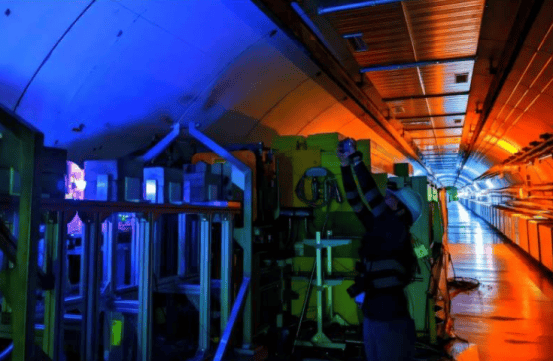
The research team produced electron-positron pairs using the Super Proton Synchrotron and injected them into a one-meter-long ambient plasma to simulate the physical processes of blazar jets propagating through intergalactic space. Blazars are active galaxies powered by supermassive black holes, whose jets of particles traveling near the speed of light produce gamma rays at tera-electronvolt levels. Theory predicts that these rays should interact with background light to produce lower-energy gamma rays, but space telescopes have consistently failed to observe these signals.
The experimental results showed that, contrary to theoretical expectations, the electron-positron beams propagated stably through the plasma without significant disturbances or self-generated magnetic fields. Professor Gianluca Gregori from the Department of Physics at the University of Oxford stated: "Our study shows how laboratory experiments can help bridge the gap between theory and observation, thereby deepening our understanding of the astrophysical objects observed by satellites and ground-based telescopes."
This discovery supports the hypothesis that primordial magnetic fields exist in intergalactic space, possibly formed in the early universe. Co-researcher Professor Bob Bingham pointed out: "These experiments demonstrate how laboratory astrophysics can test high-energy cosmic theories. By recreating relativistic plasma conditions in the laboratory, we can measure the processes that shape the evolution of cosmic jets."
The researchers believe that the formation of magnetic fields in the uniform early universe may require new physics beyond the Standard Model to explain. Upcoming observational facilities such as the Cherenkov Telescope Array are expected to provide higher-resolution data to further validate these theories. Co-researcher Professor Subir Sarkar stated that this innovative experiment opens new avenues for exploring fundamental cosmic questions.
The study reproduces extreme cosmic environments through laboratory means, providing key experimental evidence for understanding the propagation mechanisms of blazar plasma jets and the origin of cosmic magnetic fields.