
The research team led by Researcher Dingfu Shao from the Institute of Solid State Physics at the Hefei Institutes of Physical Science, Chinese Academy of Sciences, has recently made new progress in the study of antiferromagnetic tunnel junctions. They proposed a new mechanism for achieving strong spin polarization using antiferromagnetic metal interfaces. The research results were published in the journal Newton, providing new ideas for the development of novel spintronic devices.
As electronic devices develop toward miniaturization and low power consumption, spintronics technology has become an important alternative to traditional solutions. Antiferromagnetic materials are considered ideal functional materials due to their characteristics of no net magnetism, no stray fields, and fast spin response. Existing technologies mainly rely on the bulk properties of materials, limiting the application range of antiferromagnetic materials.
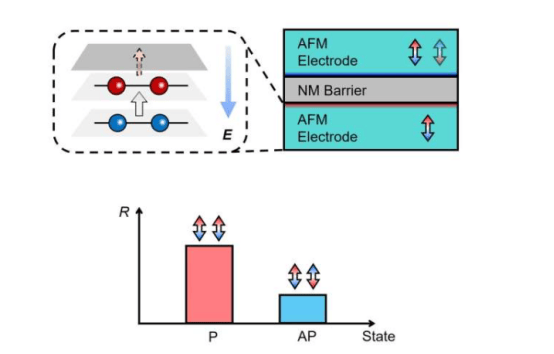
Through theoretical calculations and interface design, the research team found that certain antiferromagnetic materials can produce significant spin polarization effects in specific interface structures. They used first-principles modeling to construct a novel tunnel junction composed of the two-dimensional A-type antiferromagnetic metal Fe₄GeTe₂ and an insulating BN barrier. The study showed that although the material itself exhibits spin degeneracy in its band structure, stable spin-polarized current can still be generated through interface effects.
By adjusting the orientation of the interface magnetic moments, the team made the junction device exhibit a tunnel magnetoresistance ratio close to 100%, comparable to the performance of traditional devices. This method broadens the range of material choices for spintronic devices and provides more possibilities for device design. Professor Jose Lado from Aalto University and Professor Saroj P. Dash from Chalmers University of Technology wrote in their commentary: "The uncompensated interfaces in antiferromagnets bring new opportunities for van der Waals heterostructures," affirming the innovation and practical value of the study.
This research lays the foundation for the development of high-performance spintronic devices and demonstrates the potential of interface engineering in the development of novel electronic devices. The research results are expected to promote the development of electronic devices in the post-Moore era.