
Scientists have developed a new model called StarryStarryProcess, based on NASA's planet transit observations, to map the spot distributions on distant stars. The model builds upon decades of technical accumulation in studying stellar spots and aims to improve astronomers' understanding of spotted stars.
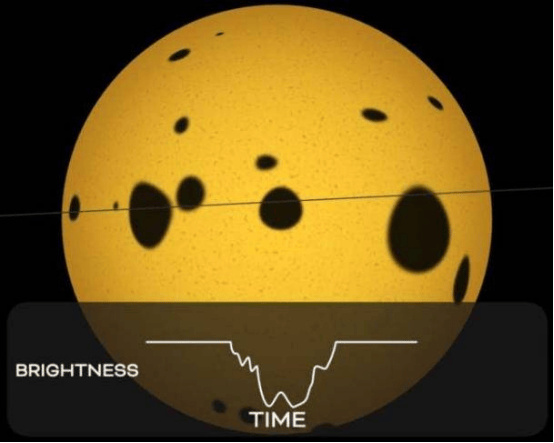
Sabrina Sargsyan, a graduate student at Stony Brook University in New York, stated: "Traditional models often assume that stars are uniformly bright disks, but real stars are much more complex. Our new model allows astronomers to understand how many starspots a star might have, their locations, and their brightness and darkness." On August 25, a paper describing the model, led by her, was published in The Astrophysical Journal.
NASA's TESS satellite and the Kepler Space Telescope identify planets through transit phenomena, and these measurements can be plotted into light curves. Usually, transit light curves show smooth variations, but occasionally there are complex small dips and peaks, representing dark features on the star's surface — starspots. The size and number of starspots change over time and affect astronomers' understanding of transiting planets. Sargsyan's model not only incorporates transit information but also includes stellar rotation, providing more detailed information about stellar properties.
"Knowing more about the star helps us better understand the planet, creating a feedback loop," said co-author Brett Morris. "For example, the star's atmosphere may contain water vapor, and when searching for water in a planet's atmosphere, we need to ensure we don't confuse the two." To test the model, the research team observed the transit of the planet TOI 3884 b, located in the northern constellation Virgo, about 141 light-years from Earth. The analysis showed that its host star TOI 3384 has a large number of starspots near its north pole and is tilted toward Earth.
Currently, Sargsyan's model is limited to visible-light band data, but NASA's upcoming Pandora mission will benefit from such tools. The Pandora small satellite will study exoplanet atmospheres and their host star activity through long-term multi-wavelength observations, improving the ability to distinguish between stellar and planetary signals.