
A research team led by Professor Lin Yiheng from the University of Science and Technology of China, in collaboration with Professor Yuan Haidong from the Chinese University of Hong Kong, has made important progress in the field of quantum information. The team successfully generated multi-body quantum entangled states spanning two, three, and five modes using an innovative dissipative engineering approach. The related results were published in the journal Science Advances.
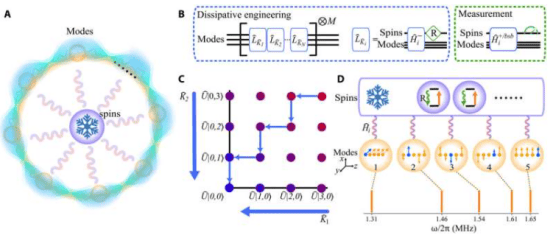
Multi-mode entanglement serves as a core resource in quantum computing, communication, and sensing, but its stable preparation has long faced challenges from environmental noise interference. Traditional methods require strict isolation of quantum systems to reduce dissipative effects, whereas this study proposes a new idea of "turning dissipation into a resource." The team achieved controllable coupling between dissipative spins and vibrational modes by precisely controlling laser operations on trapped ion chains, making the target quantum state the system’s only stable state. This design drives other states to spontaneously evolve toward the stable state, significantly enhancing the practicality and applicability of the technology.
In the experiment, the research team successfully prepared two-mode, three-mode, and five-mode squeezed entangled states from the initial thermal state, with fidelity exceeding 84% in all cases. By measuring quantum correlations between modes and applying the van Loock–Guzik inseparability criterion, they verified the genuine multi-body entanglement characteristics. This method, through precise control of the coupling between ion motion modes and internal states, can be extended to more ions and motion modes.
The universality of the dissipative engineering method further highlights its value. The study points out that this technology is not only applicable to ion trap platforms but can also be extended to various physical systems such as superconducting cavities, atomic ensembles, and nanomechanics, providing a general solution for the engineering of quantum technologies. As quantum technology develops toward system integration, dissipative-based entanglement generation methods will become a key support for building stable quantum information processing systems and will play an important role in the fields of quantum computing and multi-parameter estimation.