
In the field of visual arts, lighting effects are crucial for creating atmosphere and conveying emotion. Whether in film shooting or photography creation, creators often need to invest a lot of time and budget to carefully craft the perfect lighting in front of the lens. However, under traditional methods, once the shooting is completed, the lighting effects of photos or videos are difficult to change. Post-production "relighting" is not only time-consuming but also requires high-level skills. Although generative artificial intelligence tools attempt to simplify this process, their reliance on large neural networks and massive training images often makes the results difficult to predict and limits the creator's freedom.
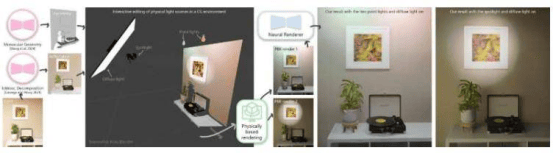
At this year's SIGGRAPH conference in Vancouver, researchers from the Computational Photography Lab at Simon Fraser University presented an innovative achievement — "Physically Controllable Relighting of Photographs". This technology introduces precise lighting control from computer graphics software into image editing. By estimating a 3D version of the scene and ignoring all lighting information, it provides users with an interactive virtual photography space. Users can freely place virtual light sources as they would in a real photography studio or 3D modeling software, and preview the scene effects under new lighting conditions in real time.
"Our method gives users the same lighting control as 3D tools such as Blender or Unreal Engine," said Chris Careaga, lead author of the study. "By simulating lighting, we ensure that the final result accurately reproduces the user's intention." In addition, the research team also developed a neural network that converts rough previews into realistic photos, further enhancing the practicality of the technology. Currently, the relighting system is mainly suitable for static images, but the team is actively exploring the possibility of extending it to the video field, in order to provide more powerful tools for visual effects artists and filmmakers.
"As the technology continues to advance, it will save independent filmmakers and content creators a lot of time and cost," emphasized Dr. Yağız Aksoy, head of the Computational Photography Lab at Simon Fraser University. "They no longer need to rely on expensive lighting equipment or reshoot; they can achieve realistic lighting adjustments in post-production."