
Scientists have basically completed the development of the High-Resolution Neutron Spectrometer (HRNS), a system that will be used to measure the number and energy of neutrons emitted by the plasma across the entire range of fusion power expected from the ITER reactor.
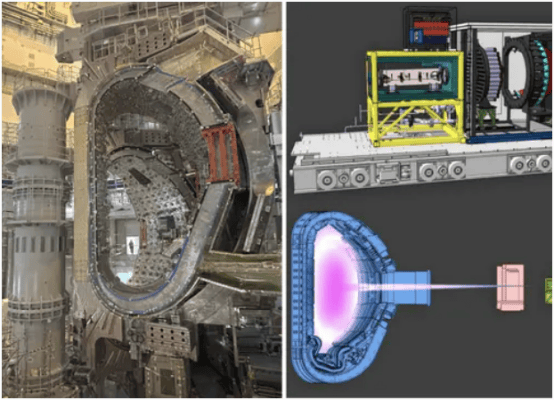
The research team stated that HRNS is one of the important plasma diagnostic devices for ITER. Its function is to perform neutron measurements of the nt/nd ratio in the plasma core. It coexists with other ITER diagnostic devices and serves as a powerful tool for efficient and precise plasma diagnostics.
Scientists pointed out that the complexity of the ITER tokamak brings many variables that were not previously considered primary concerns, such as the magnetic field in the detector area or high temperatures.
"HRNS provides us with information about the ratio of deuterium to tritium (hydrogen isotopes) in the reaction chamber," said Dr. Jan Dankowski from IFJ PAN, first author of the article describing the spectrometer. "Measuring the fast neutron population produced by the two main reactions in the plasma directly indicates fuel composition, ion temperature, and burn quality. In ITER and future reactors, this will become a key tool for controlling and optimizing reactor operation."
Dankowski emphasized that the lack of this information means losing one of the most important plasma diagnostic tools, which would seriously hinder the scientific research of ITER and the safe operation of future power reactors.
The spectrometer design is the result of the joint efforts of physicists and engineers from the Institute of Nuclear Physics of the Polish Academy of Sciences (IFJ PAN) in Krakow, Uppsala University, and the Institute of Plasma Science and Technology in Milan, developed in close cooperation with the ITER Organization.
Scientists found that the nuclei of hydrogen isotopes form plasma, and these charged plasmas can be isolated from the wall by the magnetic field inside the toroidal vacuum chamber of the reactor (tokamak). Researchers also pointed out that the plasma must be additionally heated to a temperature of 150 million Kelvin to ensure the reaction proceeds normally. The high-energy neutrons produced during the fusion process are electrically neutral and will escape to the tokamak wall, thereby recovering most of the energy produced (ultimately generating tritium when colliding with lithium).
The research team revealed that to ensure the HRNS spectrometer operates under various conditions expected from the ITER reactor, it needs to be divided into four independent sub-components. Each sub-component is a separate spectrometer operating on different principles and designed for different ranges of neutron flux intensity.
Physicists from IFJ PAN are developing the first sub-component — TPR (Thin Foil Proton Recoil). In this process, neutrons knock protons out of a thin polyethylene foil, and the scattering angle depends on the neutron energy. Nearly 100 silicon detectors are responsible for detecting the protons. According to the press release, the second sub-component is the NDD (Neutron Diamond Detector) spectrometer, which records neutrons using more than a dozen diamond detectors.
The last two sub-components, FTOF (Forward Time-of-Flight) and BTOF (Backscattering Time-of-Flight), measure the flight time of neutrons and estimate the neutron kinetic energy based on their speed. Among them, FTOF analyzes neutrons that maintain a direction similar to the original motion, while BTOF analyzes neutrons scattered at large angles.
Physicists revealed that the HRNS spectrometer will be installed behind a thick concrete shielding wall surrounding the fusion chamber, close to an opening several centimeters in diameter, so that neutrons produced in the center of the plasma can be detected. Depending on the reactor power, the neutron flux will vary dramatically, reaching hundreds of millions of particles per square centimeter per second.