
Researchers at the University of Regensburg have made progress in the study of the structure and functional dynamics of RNA exosomes by integrating experimental and computational approaches. The research was jointly conducted by teams from the Regensburg Center for Biochemistry (RCB) and the Regensburg Center for Ultrafast Nanoscopy (RUN), and the results were published in the journal Nature Communications.
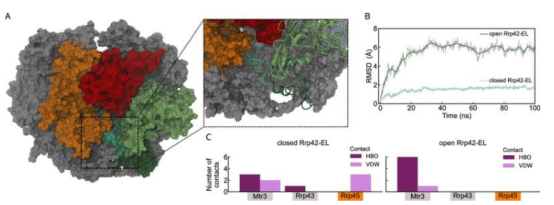
The research team resolved the static structure of the RNA exosome using cryo-electron microscopy and further observed its dynamic conformational changes by combining nuclear magnetic resonance (NMR) spectroscopy with molecular dynamics simulations. The RNA exosome is a large complex composed of 10 proteins responsible for the degradation of RNA within cells and is a key molecular machine for maintaining cellular function.
Dr. Jobst Liebau said: "We were able to measure motions in previously invisible regions, which allowed us to analyze transient interactions between RNA and the exosome." Dr. Daniela Lazzaretti noted that the new method enabled researchers to observe regions of the complex that could not be detected by previous techniques. The study revealed distinct motional characteristics in different regions of the exosome, where some slow structural changes may be directly related to the rate of RNA degradation.
Professor Remco Sprangers emphasized: "Combining different biophysical methods to elucidate structural dynamics is groundbreaking for future research. We are only just beginning to understand the role of dynamics in protein function." Professor Till Rudack further explained: "The combination of nuclear magnetic resonance and molecular dynamics simulation is equivalent to a microscope with extremely high spatial and temporal resolution."
This research approach provides a new way to understand the functional mechanisms of large protein complexes and marks a further advancement in biophysical research methodology.