
A research team led by scientists from Dayananda Sagar College of Engineering in India, with participation from researchers at Dayananda Sagar College of Engineering, Sri Venkateshwara College of Engineering, Jain University (proposed to become a university), and Nitte Meenakshi Institute of Technology, has developed a tree-type photovoltaic-wind power generation system for off-grid applications. The research results were published in the journal Franklin Open, titled "Intelligent Dual-Axis Solar Tracker for Hybrid Renewable Energy Tree System".
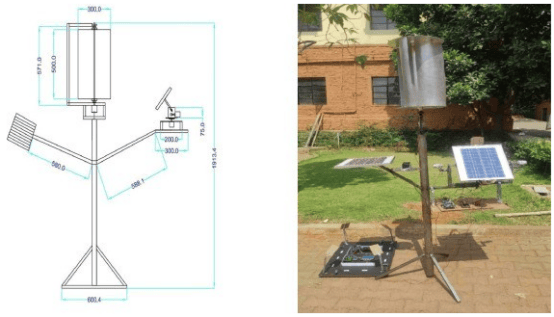
The researchers introduced that this hybrid tree is an artificial structure resembling a real tree, with solar panels or wind turbines installed on its branches. It can supply electricity for lighting loads, mobile phones, household appliances, laptops, and electric vehicles, making it an ideal energy source for green cities or smart cities. To maximize energy output, the study includes an automated dual-axis intelligent solar tracking system that can automatically position the photovoltaic panels to achieve optimal energy output anywhere in the world.
The system is called Wind-Solar Hybrid Tree (WSHT), consisting of a pole with a wind turbine (WT) mounted on top and dual-axis solar trackers installed on different branches. Initially, the WSHT was simulated in MATLAB/Simulink using one fixed photovoltaic panel, one photovoltaic panel on a dual-axis solar tracking system, and one wind turbine system. Both photovoltaic panels have a rated power of 100W, and the wind turbine has a rated power of 500W. The microcontroller system controls the direction of the dual-axis tracker through a mathematical model, using input data such as GPS data, gyroscope orientation sensors, and digital compasses. The scientists also modeled the WT unit under different wind speeds (m/s) using typical WT variables.
After simulation, the team built a semi-physical model using two real 100W photovoltaic panels (one fixed and one on a dual-axis tracker) and a simulated 500W WT (using data from the NASA database).
The WSHT was installed in the Bangalore region of India and tested for four days from 6:00 to 18:00 on January 5, May 5, September 5, and December 5, 2024. The system always used the WT, while the PV source varied, using either dual-axis or fixed PV with tilt angles of 18°, 15°, or 10° respectively.
After extensive testing of the prototype, it was found that the tracking system requires minimal operating energy. The researchers emphasized that the proposed WSHT system can generate up to 444.5 watt-hours per day when using the dual-axis tracking system, and 409.5 watt-hours per day when using solar panels installed at a fixed angle. The maximum output power of the solar module was measured at 144 watt-hours with the dual-axis tracking system and 109 watt-hours with fixed-angle solar panels. The wind turbine generates 300.5 watt-hours per day. The system can be used to power a variety of devices.