
Researchers at Waseda University in Japan have developed a hybrid approach combining origami and kirigami techniques to enhance the performance and adaptability of stretchable electronic devices. The research, led by Professor Eiji Iwase and Mr. Nagi Nakamura from the Department of Applied Mechanics and Aerospace Engineering, was published on June 5, 2025, in the journal npj Flexible Electronics.
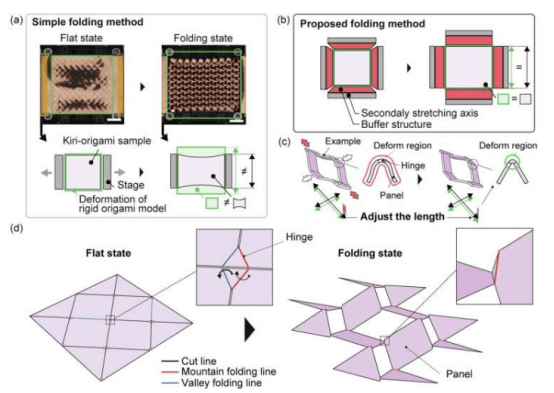
Stretchable electronics technology currently faces the challenge of balancing material performance and flexibility. Traditional elastomers have poor electrical properties, while origami- or kirigami-based structural solutions suffer from limitations in applicable area or difficulty in mounting rigid components. The "kirigami-origami" structure proposed by the Waseda team combines orthogonal cutting lines and folding lines, forming Z-shaped hinges and rotating panels during stretching. This supports large-area expansion while providing a stable mounting platform for electronic components.
Professor Iwase stated: "In this study, we propose a kirigami structure that integrates folding lines and cutting lines. It combines the advantages of origami and kirigami while compensating for their respective shortcomings. This structure enables large-unit, large-area electronic devices and allows rigid electronic components to be folded through stretching."
The research team also noticed issues with panel deformation and elastic forces in practical applications, so they developed an "elastic origami model" and buffer structures. The buffer design connects fixtures through trapezoidal extensions, resulting in a more uniform tension distribution and better simulation of the deformation behavior of rigid models. To verify the technical feasibility, the team fabricated a stretchable display containing more than 500 hinges and 145 LEDs, which maintained stable performance both before and after folding.
This kirigami-origami technique provides a new pathway for developing high-performance wearable sensors, curved displays, and flexible sensing systems for robots. Iwase added: "Our method can develop stretchable electronic devices that adapt to complex shapes without compromising performance, including next-generation high-performance wearable sensors, curved displays, and flexible sensors and actuators for human-assistive robots."