
The Solar Orbiter mission, led by the European Space Agency, has successfully classified the large number of high-energy particles released by the Sun into space — known as "Solar Energetic Electrons" (SEE) — into two groups, each corresponding to different types of eruptive activity on the Sun. The Sun, as the most energetic particle accelerator in the solar system, can accelerate electrons to near-light speeds and eject them into space, filling the solar system with SEE.
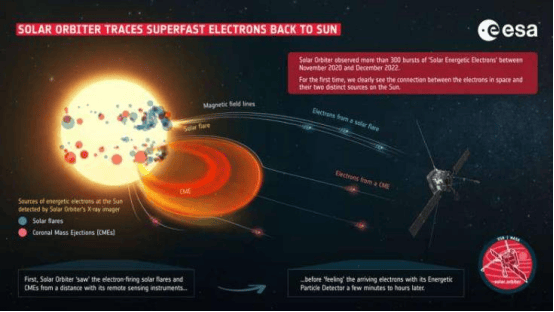
In a paper recently published in the journal Astronomy & Astrophysics, researchers used the Solar Orbiter to precisely pinpoint the origins of these high-energy electrons and track their propagation paths through space, revealing the true activity on the Sun's surface. They found that SEE events can be divided into two categories: one closely associated with solar flares (small-scale eruptions on the Sun's surface), and the other linked to coronal mass ejections (large-scale ejections of hot gas from the Sun's atmosphere). Lead author Alexander Warmuth from the Leibniz Institute for Astrophysics Potsdam explained: "We observed a clear distinction between 'impulsive' and 'gradual' particle events. The former accelerate electrons instantaneously through solar flares, while the latter are associated with more widespread coronal mass ejections, with a longer particle release process."
Thanks to its unique observational position, closer to the Sun than other missions, the Solar Orbiter was able to measure a large number of events, thereby revealing the formation mechanisms of SEE events and the processes by which they leave the stellar surface. Co-author and ESA researcher Laura Rodríguez-García noted that the observed lag between solar activity and the release of high-energy electrons is partly due to the way electrons propagate through space, including encountering turbulence and scattering in different directions. The space between the Sun and the planets is not a vacuum but is filled with a wind of charged particles streaming from the Sun, dragging the Sun's magnetic field and influencing the trajectories of high-energy electrons. Daniel Müller, ESA's Solar Orbiter Project Scientist, stated: "Thanks to the Solar Orbiter, we have gained a deeper understanding of the Sun. In its first five years in space, it has observed a large number of solar energetic electron events, allowing us to build a unique database."
This discovery is crucial for understanding space weather, as accurate forecasting is key to ensuring the normal operation of spacecraft and the safety of astronauts. In particular, SEE events associated with coronal mass ejections have a more significant impact on space weather because they carry more high-energy particles. The knowledge gained by the Solar Orbiter will help protect future spacecraft and enhance our understanding of the Sun's high-energy particles. In addition, ESA's "Vigil" mission and "SMILE" mission will further expand our understanding of solar activity and Earth's response to solar storms.