
A research team led by scientists at Pennsylvania State University has discovered that innovative improvements to classical materials can significantly advance quantum computing and help modern data centers achieve higher energy efficiency. Co-lead author of the study Venkatraman Gopalan pointed out that the newly formed material, at low temperatures, increases the speed of converting signal electrons into signal photons by more than ten times. This property is crucial for quantum technologies based on superconducting circuits.
Low-temperature operation is an indispensable condition for superconducting quantum technologies. However, information transmission between distant quantum computers relies on optical signals. Traditional room-temperature optical fibers can achieve this goal, enabling the construction of a true quantum network. High-efficiency electro-optic transducers have broad application prospects in data centers, particularly supporting various applications from artificial intelligence to online services. Data centers consume enormous amounts of energy, with cooling systems accounting for a high proportion. Optical fiber links transmit information via photons, avoiding the heat generated by electron transmission and significantly improving energy efficiency.
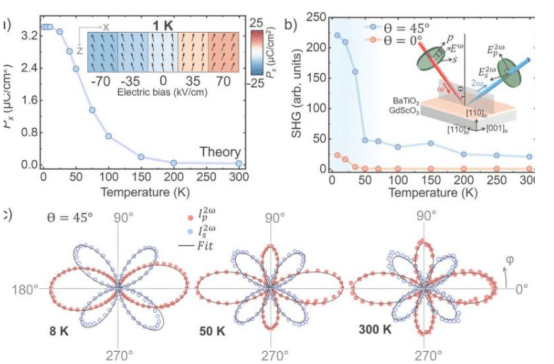
Co-lead author and Pennsylvania State University graduate research assistant Aidan Ross stated: "For large data centers that process and transmit massive amounts of data, integrated photonic technology is becoming increasingly attractive, especially with the accelerated application of artificial intelligence tools." The team used an innovative method to create extremely thin films of barium titanate and forced its atoms into new positions, forming a metastable structure. This structure not only prevents the decline of electro-optic performance at low temperatures but also exhibits extraordinary responsiveness.
Materials Science and Engineering PhD candidate Albert Suchan further explained that a metastable state refers to a crystal structure that is not in its natural lowest energy state. It exists because the researchers subjected the material to special treatment. This treatment allows the material to accept a new structure and remain stable, at least until disturbed. This discovery not only provides new ideas for energy saving in data centers but also solves the problem of long-distance information transmission in quantum computing. Currently, microwave signals decay rapidly during long-distance transmission, while optical signals are more suitable for long-distance transmission.
Another co-lead author of the study, Sankalpa Hazra, stated that the strained barium titanate thin film method is universal and can be applied to various materials. The team hopes to expand the research scope beyond barium titanate to explore the potential of more materials. Gopalan said: "Now that we have a deeper understanding of this design strategy, we also hope to apply the same method to some less-studied material systems."