
A research team from the National University of Singapore and the University of Manchester in the UK has made important progress in graphene electron mobility research. Two independent studies, through different technical approaches, have enabled graphene's electron mobility performance to surpass traditional gallium arsenide semiconductor materials for the first time.
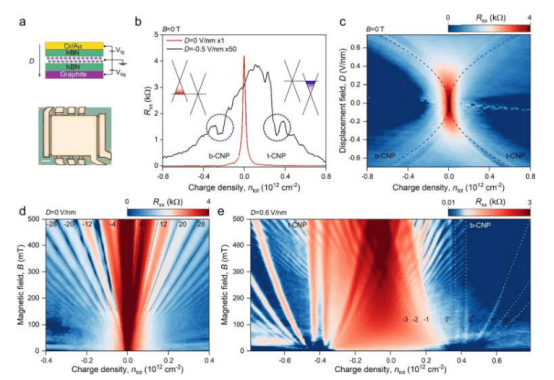
Although graphene possesses excellent electrical conductivity, its electron mobility in practical applications is often limited by material defects and environmental interference. The scattering effect caused by charged impurities leads to uneven charge density, affecting electron transport efficiency. To address this challenge, the two research teams proposed innovative solutions.
The National University of Singapore team used a twisted bilayer graphene structure as an electrostatic shield. By stacking two layers of graphene at a twist angle of 10° to 30°, the researchers successfully achieved electron decoupling and reduced charge inhomogeneity to only a few electrons per square micrometer. This method pushed the transport mobility beyond 20 million cm²/Vs, while the quantum mobility also exceeded the best gallium arsenide two-dimensional electron gas system. The research results were published in Nature Communications on August 11, 2025.
Team member Ian Babich stated: "Graphene has finally caught up with or even surpassed traditional semiconductors in some key aspects. This is a historic moment for graphene devices, allowing us to further explore subtle quantum phenomena that were previously unreachable."
The University of Manchester team adopted near-field metal shielding technology, placing graphene on an ultra-thin dielectric layer less than one nanometer away from the metal gate. This structure generates a strong Coulomb shielding effect, reducing charge inhomogeneity to the level of 3×10⁷cm⁻² and pushing the Hall mobility beyond 60 million cm²/Vs. The research was published in Nature on August 20, 2025.
National University of Singapore Assistant Professor Alexey Berdyugin stated: "These methods together expand our experimental toolkit and will benefit research in the field of two-dimensional materials. They not only open opportunities for fundamental research but also for high-performance applications where ultra-clean materials are critical."
These breakthroughs are expected to promote the development of quantum metrology, high-speed electronic technology, and quantum information technology, providing a superior material platform for next-generation electronic devices. The research team plans to apply these technologies to more complex graphene heterostructure studies in the next step.