
Researchers at the National Institute of Standards and Technology (NIST) have developed a cryogenic decay energy spectrometry technique that can detect individual radioactive decay events from tiny material samples and identify the atoms involved. According to an article published by NIST on July 8, this technology is expected to replace characterization tasks that previously took months, supporting the development of radiopharmaceuticals and the recycling of spent nuclear fuel.
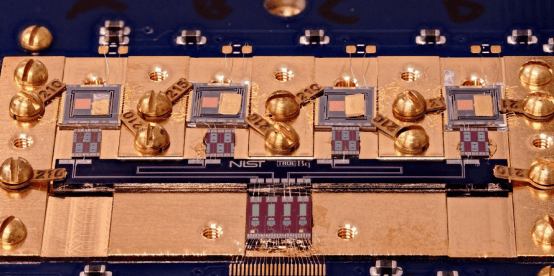
NIST launched a multidisciplinary project called "TrueBq" in fiscal year 2021 to standardize radioactive nuclides. The research team recently published primary activity measurement results for an americium-241 solution in the journal Metrologia. Test solution samples were first sprayed in precisely measured microgram quantities onto a gold foil surface with nanopores using inkjet technology. A precision mass balance system measures the mass of the sprayed material, allowing researchers to accurately know the material content in each dried inkjet droplet. NIST hopes that the TrueBq method will replace traditional workflows, shortening analysis time and improving accuracy.
The key to this new technology lies in the Transition Edge Sensor (TES), which is used to measure radiation signatures at temperatures close to absolute zero. The energy released by radioactive decay is absorbed by the TES, causing a change in the device's resistance. This change serves as the "signature" of the decay event. Researchers accumulate data to build detailed energy spectra for identifying radioactive nuclides. Because they know the exact mass of the test material, they can calculate the radioactivity per unit mass of the sample (massic activity) with unprecedented precision.
NIST physicist Ryan Fitzgerald said that TES is far more advanced than common detectors such as Geiger counters and can obtain detailed "fingerprint" information about the material. He also noted that what previously required waiting months for results can now be obtained from small samples in just a few days, providing a complete radioactive profile.
According to NIST, this technology may in the future ensure the purity and efficacy of radiopharmaceuticals used in cancer treatment, rapidly identify the radioactive components of reprocessed spent fuel, and accelerate the development of advanced reactors and their fuels. Currently, TrueBq focuses on improving NIST's measurement work, including calibrations and the production of standard reference materials for clients. NIST also stated that in the future, researchers hope to develop a more portable and user-friendly version of the system for deployment outside NIST, to be used in key areas such as medicine, environmental cleanup, and nuclear waste management.