
A research team from Hokkaido University and the University of Toyama in Japan has recently made progress in the field of soft-hard composite materials. By establishing a minimal three-dimensional model, they have revealed the toughening mechanism of this type of material. The research results have been published in the Proceedings of the National Academy of Sciences (PNAS).
Biological materials in nature, such as bone and nacre, achieve a balance between strength and toughness through multilayer combinations of soft and hard components. This characteristic provides important reference for the design of artificial composite materials. However, due to the complexity of the internal structure and multi-scale interactions within the materials, the core principles of the toughening mechanism have long remained unclear.
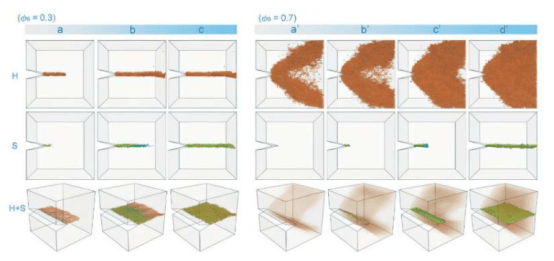
The research team was led by Dr. Tian Fucheng from the Faculty of Advanced Life Science at Hokkaido University, Professor Gong Jianping, and Professor Katsuhiko Sato from the University of Toyama. They constructed a simplified three-dimensional soft-hard composite material model, focusing on the basic physical principles of material toughening through the random distribution of linearly elastic soft and hard elements. The model successfully reproduces the typical mechanical behavior of tough composite materials, including mechanical hysteresis effects and brittle-to-ductile transition characteristics.
The study found that when the soft and hard phases reach a specific mechanical balance, the material undergoes a brittle-to-ductile transition. The optimal toughening effect occurs at a specific ratio of soft and hard components, at which point the toughness of the composite material can surpass the individual performance of each component. Dr. Tian Fucheng stated: "Although the model is based on a linear elastic system, its results are highly consistent with experimental data from nonlinear soft-hard composite materials, revealing the universal principles behind the toughening mechanism."
Based on the above findings, the team mapped a "toughening phase diagram," providing a practical guide for material design and indicating the optimal combination range of component stiffness and toughness. The universality of the model suggests that its principles can be widely applied to the design of various composite materials.
The research results are expected to promote the development of high-performance materials in fields such as aerospace and the automotive industry, while also holding application potential in biomedical fields such as tissue engineering and medical devices that require high-toughness gels.